Freedom251 › Sales Funnel Builders

Autonnel
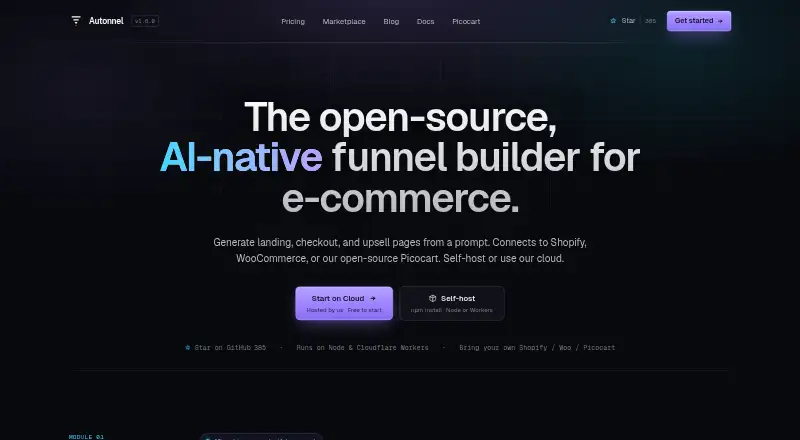
What Autonnel is
Autonnel is an open-source, AI-native funnel builder for e-commerce. It generates landing, checkout, and upsell pages from prompts, and its page builder lets users compose real components on a canvas. Edits are represented as diffable JSON. Funnel analytics report conversion and drop-off step by step, with 17 built-in payment and form events that can be queried using DuckDB.
A scheduled analysis agent sends funnel data through an LLM and can notify a team when performance changes. Listed commerce adapters are Shopify, WooCommerce, and the open-source Picocart. Documentation lists Stripe and PayPal payments and conversion postbacks for Facebook, TikTok, Bing, and Google. Post-purchase offers can charge a saved card in one step without another checkout.
The product includes an MCP server, Claude skills, and an API that uses scoped Bearer keys. Autonnel can be self-hosted with Docker or Node.js, or deployed to Cloudflare Workers. Its Self-hosted plan is free and includes all adapters, with users bringing their own LLM key. Managed costs $29 a month, with 0% of revenue and free building and testing; a custom domain starts the paid plan. Autonnel uses the Apache-2.0 license, which permits commercial, modified, and private use.
Who it suits
Autonnel suits e-commerce teams that want to create and measure landing, checkout, and upsell funnels, with commerce and payment adapters listed for their stack. Its free self-hosted plan is described for hackers, open-source maintainers, and teams running their own infrastructure; Managed is available for teams that prefer a cloud plan.
What it does well
- Generates landing, checkout, and upsell pages from prompts.
- Tracks funnel conversion and drop-off by step.
- Includes 17 payment and form events queryable with DuckDB.
- Lists Shopify, WooCommerce, and Picocart commerce adapters.
- Supports self-hosting and Cloudflare Workers deployment.
- Apache-2.0 permits commercial, modified, and private use.
What to know first
- Self-hosting requires session and credential-encryption secrets outside development.
- Self-hosted documentation says there is no open registration.
- The free plan requires users to bring their own LLM key.
- Custom domains start the paid Managed plan.
Limits
The free Self-hosted plan requires users to bring their own LLM key and run their own infrastructure. On Managed, a custom domain starts the paid plan; building and testing are free, and the plan charges 0% of revenue.
Plans
| Plan | Billed and limits | Price |
|---|---|---|
| Self-hosted | $0 forever · Self-host on Node or Cloudflare Workers · bring your own LLM key · all adapters included | Free |
| Managed | $29 / mo flat · 0% of revenue · free to build and test; custom domain starts paid plan · marketplace templates and plugins included | $29 a month |
| Enterprise | Contact us · Dedicated resources · SSO/SAML · on-prem option · priority SLA | On request |
As autonnel.com lists them, read 30 Sept 2026. The maker's own page has the final word.
Getting started
- Visit the Autonnel website.
- Choose the free Self-hosted plan or the Managed plan at $29 a month.
- For self-hosting, deploy with Docker or Node.js, or use Cloudflare Workers.
- For self-hosting outside development, configure session and credential-encryption secrets.
- Bring your own LLM key for the Self-hosted plan.
- Connect a listed commerce adapter such as Shopify, WooCommerce, or Picocart.
Autonnel is an open-source funnel builder for e-commerce, with prompt-generated landing, checkout and upsell pages. It best suits teams that want to shape and operate their own funnel stack, while its managed option gives teams a hosted route. Its appeal is the combination of structured page editing, commerce tools and deployment choice; the trade-off is that self-hosting also means managing infrastructure and an LLM key.
Overview
Autonnel brings funnel creation, checkout and performance analysis into one product. Its canvas builder works with real components, and records edits as diffable JSON—a useful distinction for teams that want changes represented in a form they can inspect rather than only through a visual editor.
The project uses the Apache-2.0 license, which permits commercial, modified and private use. That makes it a plausible foundation for teams adapting the software, but does not remove the operational work of deploying and securing it.
Key features
- Prompt-generated pages: Generate landing, checkout and upsell pages from prompts, then edit their components on a canvas. This suits teams looking to accelerate page creation without giving up a visual editing surface.
- Commerce and payments: Adapters include Shopify, WooCommerce and the open-source Picocart; payment documentation lists Stripe and PayPal. Conversion postbacks cover Facebook, TikTok, Bing and Google, making the product relevant to shops that need funnel activity connected with ad platforms.
- Post-purchase offers: One-click upsells charge the saved card without sending the buyer through another checkout. That can reduce friction in an offer flow, though it depends on having a saved payment method.
- Funnel analytics: Step-by-step conversion and drop-off reporting uses 17 built-in payment and form events queried with DuckDB. This provides more than a page builder alone, with event-based funnel analysis built in.
- Scheduled analysis: An agent sends funnel data through an LLM and can notify a team when performance changes. Teams should account for the required LLM key when choosing self-hosting.
- Developer access: An MCP server, Claude skills and an API with scoped Bearer keys provide integration and automation paths for technical teams.
- Checkout and testing: Built-in checkout, upsells and order bumps, email automation, A/B testing and custom domains cover core funnel needs. A custom domain starts with the paid plan.
Pricing
Self-hosted is free, billed $0 forever. It includes self-hosting on Node or Cloudflare Workers and all adapters, but requires your own LLM key and infrastructure. It fits technically capable users who value control and are prepared to deploy and maintain the service. The setup is not turnkey: the self-hosting documentation requires session and credential-encryption secrets outside development, and there is no open registration.
Managed costs $29 a month, billed $29 / mo flat, with 0% of revenue. Building and testing are free; a custom domain starts the paid plan. Marketplace templates and plugins are included, as are email and Slack support. This is the clearest fit for teams that want hosting and support without a revenue share, but need a custom domain or the included marketplace resources.
Enterprise has custom pricing. It adds dedicated resources, SSO/SAML, an on-prem option and a priority SLA, making it the relevant tier for organizations with deployment or service-level requirements beyond the managed plan.
Platforms
Autonnel is available through the web and API, and supports Linux and self-hosted deployment. Self-hosting options include Docker or Node.js, as well as Cloudflare Workers. That range gives infrastructure-owning teams deployment flexibility, while the managed plan avoids running the application themselves.
Who it's for
Autonnel is strongest for e-commerce teams that want prompt-assisted funnel building alongside checkout, post-purchase offers and conversion analysis. Its self-hosted plan is explicitly suited to hackers, open-source maintainers and teams running their own infrastructure. Less technical operators who want a custom domain can choose Managed, but should weigh the monthly fee against the additional control of running it themselves.
Pros and cons
- Pro: Apache-2.0 licensing and self-hosting support give technical teams room to run and adapt the software for commercial use.
- Pro: Page generation, checkout, one-click upsells, email automation and funnel analytics sit in the same product.
- Pro: Managed pricing is a flat $29 a month with 0% of revenue, rather than a revenue-based fee.
- Con: The free self-hosted route requires an LLM key, infrastructure and security configuration, so its zero price does not mean zero operational effort.
- Con: Custom domains require the paid plan, which limits the usefulness of free building and testing for a live branded storefront.
- Con: Enterprise capabilities come with custom pricing, so organizations cannot compare that tier against a published fixed price.
Alternatives
Browse Sales Funnel Builders for more options. ConvertFlow is worth considering if a free plan with five funnel campaigns and previews is the priority; integrations require its paid plan. Fynlix may suit a buyer wanting a free forever tier with 30 AI credits monthly, three funnels, one seat, checkout, upsells and analytics.
Influx OS offers a free platform-exploration tier and a paid Launch plan, so it may suit readers comparing a free starting point before selecting paid service. Launchtic is another self-hosted option, with a free tier allowing one workspace and one admin alongside unlimited funnels, contacts, workflows, broadcasts and domains.
OpenFunnels is an alternative open-source, self-hosted funnel product. Systeme.io may be preferable to readers who want its free plan's 2,000 contacts, three sales funnels, one course, one blog and one custom domain.
CartFlows is an option for readers seeking a self-hosted funnel builder for a website, while FunnelKit is another self-hosted alternative with checkout-focused plans.
Verdict
Choose Autonnel if you want an open-source e-commerce funnel builder that combines prompt-generated pages, checkout, post-purchase offers and event-based analytics, with the option to self-host or pay for managed service. Its strongest case is for technical teams that value control without sacrificing commerce functionality. Look elsewhere if you need a fully hands-off free service: the self-hosted option requires your own infrastructure and LLM key, and branded custom domains start with the paid plan.
Verdict
Choose Autonnel if you want an open-source funnel builder with prompt-generated pages, funnel analytics, and self-hosting options. Self-hosted is free but requires your own LLM key and infrastructure; Managed costs $29 a month, and Enterprise pricing requires contacting the company.
Questions
Is Autonnel open source?
Yes. It is licensed under Apache-2.0, which its About page says permits commercial, modified, and private use.
What does the free plan include?
Self-hosted is free forever, supports Node or Cloudflare Workers, requires users to bring their own LLM key, and includes all adapters.
How much is the Managed plan?
Managed costs $29 a month. It charges 0% of revenue, and building and testing are free.
Which platforms can Autonnel run on?
It lists API, Linux, self-hosted, and web platforms. Deployment options include Docker or Node.js self-hosting and Cloudflare Workers.
Which commerce and payment integrations are listed?
Commerce adapters include Shopify, WooCommerce, and Picocart. Documentation lists Stripe and PayPal payments.
Who makes Autonnel?
Its About page describes it as built by a small team but does not state a company name.
Facts from Autonnel's own pages
- AI/API
- The product includes an MCP server, Claude skills, and an API using scoped Bearer keys. · autonnel.com, 30 Sept 2026
- Analysis
- A scheduled analysis agent sends funnel data through an LLM and can notify a team when performance changes. · autonnel.com, 30 Sept 2026
- Analytics
- Funnel analytics include step-by-step conversion, drop-off, and 17 built-in payment and form events queried with DuckDB. · autonnel.com, 30 Sept 2026
- Commerce integrations
- The product lists Shopify, WooCommerce, and its open-source Picocart as commerce adapters. · autonnel.com, 30 Sept 2026
- Company
- The About page describes Autonnel as built by a small team but does not state a company name, headquarters, or founding date. · autonnel.com, 30 Sept 2026
- Deployment
- Autonnel can be self-hosted with Docker or Node.js, or deployed to Cloudflare Workers. · autonnel.com, 30 Sept 2026
- Editing
- Its page builder composes real components on a canvas, with edits represented as diffable JSON. · autonnel.com, 30 Sept 2026
- Intended users
- The self-hosted plan is described for hackers, open-source maintainers, and teams that run their own infrastructure. · autonnel.com, 30 Sept 2026
- License
- Autonnel is licensed under Apache-2.0, which its About page says permits commercial, modified, and private use. · autonnel.com, 30 Sept 2026
- Payments and ads
- Documentation lists Stripe and PayPal payments and conversion postbacks for Facebook, TikTok, Bing, and Google. · autonnel.com, 30 Sept 2026
- Purpose
- Autonnel is an open-source, AI-native funnel builder for e-commerce that generates landing, checkout, and upsell pages from prompts. · autonnel.com, 30 Sept 2026
- Security and access
- Self-hosting documentation requires session and credential-encryption secrets outside development and says there is no open registration. · autonnel.com, 30 Sept 2026
- Support
- The Cloud plan includes email and Slack support; the self-hosted plan lists GitHub Issues and Discussions. · autonnel.com, 30 Sept 2026
- Upsells
- Autonnel supports one-click post-purchase offers charged to the saved card without a second checkout. · autonnel.com, 30 Sept 2026
Where Autonnel stands on Freedom251
- Sales Funnel Builders#1 of 29