Freedom251 › AI Audiobook Generators
Auto-Audiobook
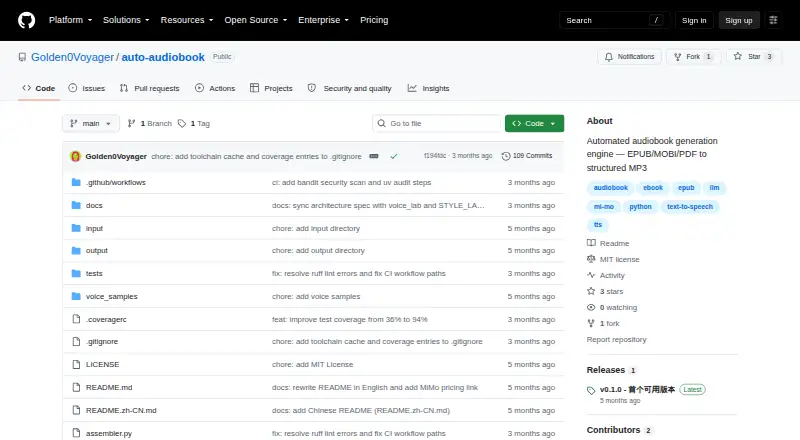
What Auto-Audiobook is
Auto-Audiobook is a free, MIT-licensed, self-hosted project that turns EPUB, MOBI, and PDF books into structured MP3 audiobooks. It uses MiMo-V2.5-TTS through an OpenAI-compatible API and requires a Xiaomi MiMo API key configured in an environment variable. The README lists four Chinese voices and four English voices, with voice selection and preview, plus Default, News, Story, Biography, and Knowledge reading styles. Processing supports concurrent synthesis, chapter resume, incremental work, and watchdog mode that processes new files placed in an input directory. Output is 256 kbps mono MP3 with ID3 title, author, and chapter tags. The project is optimized for Chinese and English and detects language from sampled text. Rule-based cleaning is the default and is described as having zero API cost; LLM cleaning is also available. Other TTS engines require modifying the synthesis function. The maker describes personal listening as the intended use and advises against uploading complete commercial readings publicly.
Who it suits
It suits people comfortable installing Python software locally who want self-hosted audiobook generation for Chinese or English books and personal listening.
What it does well
- Supports EPUB, MOBI, and PDF input
- Chapter resume and incremental processing
- Watchdog mode processes new files
- Eight listed voices across two languages
- MIT-licensed and open source
What to know first
- Requires a MiMo API key
- Other TTS engines need code changes
- Optimized only for Chinese and English
- Commercial audiobook sharing is restricted
Limits
The project is optimized for Chinese and English, and its default TTS integration is MiMo-V2.5-TTS. Other TTS engines require editing the synthesis function, while the maker advises personal use and cautions against public uploads of complete commercial readings.
Getting started
- Open the Auto-Audiobook GitHub website
- Install the Python project locally
- Set a Xiaomi MiMo API key in an environment variable
- Provide an EPUB, MOBI, or PDF input file
- Choose a voice and reading style
- Run synthesis and retrieve the generated MP3 audiobook
Verdict
Auto-Audiobook provides local, automated book-to-MP3 conversion with chapter handling and selectable voices. Its MiMo dependency, language focus, and stated personal-use guidance are important constraints.
Questions
Is Auto-Audiobook free?
Yes. It is described as free and open source under the MIT license.
Which files can it convert?
It converts EPUB, MOBI, and PDF books into structured MP3 audiobooks.
Which languages and voices are available?
The README lists four Chinese voices and four English voices. The project is optimized for Chinese and English and detects language from sampled text.
What audio format does it produce?
Generated audio is 256 kbps mono MP3 with ID3 title, author, and chapter tags.
Does it support other TTS engines?
Other engines are not integrated by default; using them requires modifying the synthesis function.
Can I publish the audiobooks commercially?
The maker describes personal listening as the intended use and advises against uploading full commercial-book readings to public platforms.
Facts from Auto-Audiobook's own pages
- Audio output
- Generated audio is 256 kbps mono MP3 with ID3 title, author, and chapter tags. · github.com, 8 Oct 2026
- Automation
- Watchdog mode monitors a directory and processes new files automatically. · github.com, 8 Oct 2026
- Cleaning
- Rule-based text cleaning is the default and is described as having zero API cost; LLM-based cleaning is also available. · github.com, 8 Oct 2026
- Copyright guidance
- The README advises personal use and says not to upload full audiobooks to public platforms. · github.com, 8 Oct 2026
- Integration limit
- The README says the software is deeply integrated with MiMo’s API and other TTS engines require modifying synthesizer.py. · github.com, 8 Oct 2026
- Intended use
- The maker describes building it for personal listening and advises against uploading full audiobook readings of commercial publications to public platforms. · github.com, 8 Oct 2026
- Languages
- The project says it is currently optimized for Chinese and English, with automatic language detection from text samples. · github.com, 8 Oct 2026
- Language support
- The project says it is currently optimized for Chinese and English, with language detection based on text sampling. · github.com, 8 Oct 2026
- License
- The project is licensed under MIT. · github.com, 8 Oct 2026
- Other TTS engines
- The README says other TTS engines are not integrated by default and would require modifying the synthesis function. · github.com, 8 Oct 2026
- Pricing
- The repository does not list Auto-Audiobook plans or prices; it notes that MiMo-V2.5-TTS was in a limited-time free trial when the README was written. · github.com, 8 Oct 2026
- Processing
- It supports concurrent synthesis, chapter resume, incremental processing, and monitoring an input directory for new files. · github.com, 8 Oct 2026
- Purpose
- Auto-Audiobook converts EPUB, MOBI, and PDF books into structured MP3 audiobooks. · github.com, 8 Oct 2026
- Reading styles
- Available styles are Default, News, Story, Biography, and Knowledge. · github.com, 8 Oct 2026
- Security
- The README requires a Xiaomi MiMo API key configured through an environment variable and does not describe security or compliance certifications. · github.com, 8 Oct 2026
- Setup
- The README instructs users to install the Python project locally and provide a MiMo API key. · github.com, 8 Oct 2026
- Speech engine
- It uses MiMo-V2.5-TTS through an OpenAI-compatible API. · github.com, 8 Oct 2026
- Synthesis
- It uses MiMo-V2.5-TTS through an OpenAI-compatible API for concurrent audio synthesis. · github.com, 8 Oct 2026
- Voice options
- The README lists four Chinese voices and four English voices. · github.com, 8 Oct 2026
- Voices
- The README lists four Chinese voices and four English voices, with voice selection and preview. · github.com, 8 Oct 2026
Where Auto-Audiobook stands on Freedom251
- AI Audiobook Generators#15 of 25