Freedom251 › Identity Threat Detection and Response Software

AuthMind Advanced Identity Threat Detection and Response
Visit AuthMind Advanced Identity Threat Detection and Response Alternatives
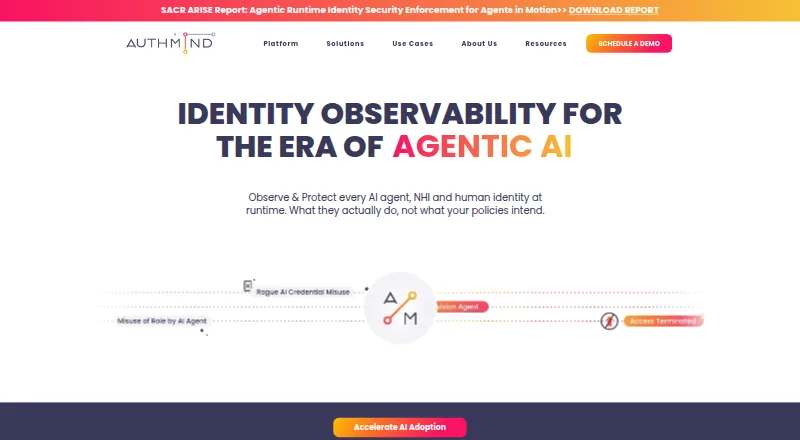
What AuthMind Advanced Identity Threat Detection and Response is
AuthMind Advanced Identity Threat Detection and Response combines identity security posture management with threat detection and response. It finds human identities, non-human identities, and AI agents, including unknown identities, and links them to owners. By correlating identity and system events with network, cloud, and application or service logs, it maps access routes and builds a live Identity Activity Access Graph showing connections to applications, services, data, and infrastructure. Detection includes compromised identities, brute-force attacks, secret misuse, unusual agent activity, missing MFA, token theft, session hijacking, privilege abuse, lateral movement, and shadow access. Its response framework works across identity providers, endpoints, networks, SASE, PAM, and security tools. Listed integrations include Okta, Microsoft Entra ID, Splunk, CrowdStrike, AWS, Zscaler, HashiCorp Vault, and ServiceNow. The platform covers cloud, SaaS, on-premises environments, networks, and systems, and is offered as proprietary SaaS with web and self-hosted platforms. Pricing is on request; fees are based on services purchased, not actual usage, and unused prepaid fees are not refunded. The default subscription term is one year with automatic annual renewal.
Who it suits
It suits organizations seeking to map identity access and detect identity threats across cloud, SaaS, on-premises, network, and system environments. Buyers should be prepared to request pricing and review the default annual subscription terms.
What it does well
- Maps human, non-human, and AI-agent identities to owners
- Detects credential theft and privilege abuse
- Response spans identity providers, endpoints, and security tools
- Integrates with Okta, Microsoft Entra ID, and AWS
- States SOC 2 Type II compliance and independent audits
What to know first
- Pricing is available on request
- Default subscription term is one year
- Unused prepaid access fees are not refunded
Limits
Fees are set in the applicable agreement and are based on services purchased rather than actual usage. Unless an agreement says otherwise, the initial subscription term is one year and renews automatically for successive one-year terms; prepaid fees for unused access are not refunded.
Getting started
- Visit the AuthMind website.
- Register for a one-to-one platform demo.
- Discuss pricing and fees with AuthMind; pricing is on request.
- Arrange an agreement covering the subscription and services.
AuthMind Advanced Identity Threat Detection and Response is identity-security software for organizations tracking human, machine, and AI-agent access across complex environments. It suits security teams that need a consolidated view from cloud and SaaS to on-premises systems and networks. Its broad detection and response coverage is the main attraction, while custom commercial terms and a default annual commitment demand careful procurement.
Overview
AuthMind discovers known and unknown human identities, non-human identities, and AI agents, then maps each to an owner. It correlates identity events with network, cloud, and application or service telemetry, producing a real-time Identity Activity Access Graph. That graph shows paths into applications, services, data, and infrastructure, which is more useful than an identity-provider-only view when access is spread across several environments.
The Advanced ITDR capability covers external and insider risks such as token theft, session hijacking, privilege abuse, lateral movement, and shadow access. Detection also includes compromised identities, brute-force attacks, secret misuse, unusual agent activity, missing MFA, credential theft, and directory attacks. The scope is substantial, but the proprietary SaaS is intended to integrate with a customer’s network, systems, and software infrastructure; organizations should expect an integration project rather than a self-contained deployment.
Key features
- Identity mapping: Linking unknown as well as known identities to owners helps teams investigate accountability gaps, especially where service accounts and AI agents outnumber employees.
- Access visibility: Correlation of identity, system, network, cloud, and application events creates a cross-environment access picture instead of isolated alerts.
- Threat detection: Coverage from secret misuse and missing MFA to token theft and privilege abuse addresses both common control failures and more advanced identity attacks.
- Automated response: Remediation can reach identity providers, endpoints, networks, SASE, privileged-access management, and other security tools. That breadth can shorten containment, provided the relevant integrations are connected and configured.
- Integrations: Listed connections include Okta, Microsoft Entra ID, Splunk, CrowdStrike, AWS, Zscaler, HashiCorp Vault, and ServiceNow, giving teams recognizable control and workflow options.
- Security assurance: AuthMind states that the platform is SOC 2 Type II compliant and independently audited for security, availability, and confidentiality—useful assurance for buyers with vendor-risk requirements.
Pricing
AuthMind uses paid, quote-based pricing. The maker invites prospects to a one-to-one platform demo, and fees are set in the applicable agreement and payable in U.S. dollars unless that agreement says otherwise. There are no published plans, seat allowances, usage quotas, or trial terms to compare, so buyers must obtain a tailored proposal to assess fit.
The commercial terms matter as much as the quote. Unless an agreement states otherwise, the initial subscription runs for one year and renews automatically for successive one-year terms. Fees are based on the services purchased rather than actual usage, and prepaid fees are not refunded for unused access. That structure favors organizations ready to commit to a defined deployment; it is less suitable for teams wanting a short pilot or billing that follows fluctuating consumption.
Platforms
AuthMind is delivered as proprietary software as a service and supports web access and self-hosted deployment scope. Its stated coverage spans cloud, SaaS, on-premises environments, networks, and systems. The product is therefore aimed at organizations that can connect multiple infrastructure and security sources, not users seeking a standalone desktop or mobile utility.
Who it's for
Choose AuthMind when identity risk crosses people, service accounts, AI agents, applications, and infrastructure, and when a security team needs both an access graph and response actions. It is particularly relevant to enterprises with mixed cloud and on-premises estates, identity-provider sprawl, or a requirement to investigate insider and external threats in one workflow.
Look elsewhere if you need transparent self-serve pricing, a lightweight identity-only monitor, or a commitment that scales directly with usage. AuthMind’s integration-led SaaS model and annual renewal make it a strategic platform purchase rather than an experiment for a small team.
Pros and cons
Pros
- Broad identity coverage: Human, non-human, AI-agent, known, and unknown identities can be mapped to owners.
- Cross-environment access graph: Correlating identity and infrastructure telemetry clarifies routes to data and services.
- Wide response reach: Remediation can span identity, endpoint, network, SASE, PAM, and security tooling.
- Serious threat scope: Detection includes credential theft, directory attacks, token theft, privilege abuse, and unusual agent behavior.
Cons
- Custom pricing: Without published plans or quotas, budgeting and comparison require a sales process.
- Annual default term: Automatic one-year renewal reduces flexibility for short evaluations.
- Usage-independent fees: Prepaid access is not refunded when capacity goes unused.
- Integration dependency: The platform’s value depends on connecting customer infrastructure and telemetry.
Alternatives
Identity Threat Detection and Response Software is the broader category guide for comparing products with this focus.
- Blumira suits buyers wanting a published $12.00 USD-per-month Detect plan, cloud and local-network SIEM visibility, pre-tuned detections, and one-year log retention.
- Duo Mobile is the better fit for straightforward MFA, with a free 10-user tier and a $3.00 USD-per-month Duo Essentials plan adding phishing-resistant and passwordless authentication.
- Bitdefender Total Security fits consumers seeking broad device protection, including a free option and a five-device, one-account plan priced at $59.99 a year for the first year.
- Palo Alto Networks Cortex Cloud API Security is an alternative when API security is the primary requirement.
- Semperis Identity Resilience Platform is another enterprise identity-resilience option with self-hosted, web, API, and Windows coverage and personalized pricing.
- Varonis Data Discovery and Classification is worth considering when data discovery and classification are central, with quote-based pricing.
- Gurucul Identity Threat Detection and Response is an alternative identity-threat platform delivered through API and web access.
- Reco is another paid API and web option for identity-security needs.
Verdict
AuthMind is a strong choice for enterprise security teams that need identity ownership, cross-environment access mapping, and response controls in one platform. Choose it for the breadth of its identity and threat coverage; look elsewhere if transparent pricing, usage-based fees, or a short, low-commitment evaluation matters more than a strategic integrated deployment.
Verdict
AuthMind brings identity mapping, threat detection, and response into a platform spanning cloud and on-premises environments. Pricing and subscription terms require attention before purchase.
Questions
How much does AuthMind cost?
Pricing is on request. Fees are set in the applicable agreement and quoted and payable in U.S. dollars unless otherwise specified.
Which platforms does AuthMind support?
The listed platforms are web and self-hosted. The service is described as proprietary software as a service designed to integrate with customer infrastructure.
What identities and threats does it cover?
It maps human identities, non-human identities and AI agents to owners. Detection includes compromised identities, brute-force attacks, secret misuse, missing MFA, token theft, session hijacking, privilege abuse, lateral movement and shadow access.
Which integrations are listed?
Listed integrations include Okta, Microsoft Entra ID, Splunk, CrowdStrike, AWS, Zscaler, HashiCorp Vault and ServiceNow.
What is the subscription term?
Unless the agreement specifies otherwise, the initial term is one year and renews automatically for successive one-year terms.
How can I learn more about the platform?
AuthMind invites visitors to register for a one-to-one platform demo. Its contact email is [email protected].
Facts from AuthMind Advanced Identity Threat Detection and Response's own pages
- Access graph
- AuthMind builds a real-time Identity Activity Access Graph to map how identities access applications, services, data, and infrastructure. · authmind.com, 30 Sept 2026
- Access visibility
- AuthMind correlates identity and system events with network, cloud, and application or service logs to map access paths. · authmind.com, 29 Sept 2026
- Commercial terms
- The SaaS terms state that fees are set in the applicable agreement, quoted and payable in U.S. dollars unless otherwise specified, and that the default initial subscription term is one year unless the agreement specifies otherwise. · authmind.com, 30 Sept 2026
- Company founding
- AuthMind says it was founded by industry veterans but does not state a founding year on its About page. · authmind.com, 30 Sept 2026
- Deployment scope
- The platform page describes coverage across cloud, SaaS, on-premises, networks, and systems. · authmind.com, 30 Sept 2026
- Founded
- 2020 · authmind.com, 23 Sept 2026
- Headquarters
- AuthMind lists its USA address as 6701 Democracy Blvd, Suite 300, Bethesda, MD 20817. · authmind.com, 30 Sept 2026
- Identity coverage
- The platform discovers and maps AI agents, non-human identities, and human identities to their owners. · authmind.com, 29 Sept 2026
- Identity mapping
- The platform maps known and unknown identities to their owners and correlates identity events with network, cloud, and application telemetry. · authmind.com, 30 Sept 2026
- Integrations
- Listed integrations include Okta, Microsoft Entra ID, Splunk, CrowdStrike, Zscaler, AWS, ServiceNow, HashiCorp Vault, and IBM QRadar. · authmind.com, 30 Sept 2026
- ITDR
- The Advanced ITDR solution targets external and insider identity threats, including token theft, session hijacking, privilege abuse, lateral movement, and shadow access. · authmind.com, 30 Sept 2026
- Notable fee condition
- The SaaS terms say fees are based on services purchased rather than actual usage, and prepaid fees are not refunded for unused access. · authmind.com, 30 Sept 2026
- Product
- AuthMind describes its platform as identity observability and protection for agentic AI, non-human, and human identities. · authmind.com, 30 Sept 2026
- Response
- AuthMind says its remediation framework supports response across identity providers, endpoints, networks, SASE, PAM, and security tools. · authmind.com, 30 Sept 2026
- Sales and support
- The site invites visitors to register for a one-to-one platform demo and lists [email protected] as its contact email. · authmind.com, 30 Sept 2026
- Security assurance
- AuthMind states that it is SOC 2 Type II compliant and independently audited for platform security, availability, and confidentiality. · authmind.com, 30 Sept 2026
- Security compliance
- AuthMind states that its platform is SOC 2 Type II compliant and independently audited for security, availability, and confidentiality. · authmind.com, 29 Sept 2026
- Service model
- AuthMind describes the service as proprietary software as a service designed to integrate with a customer's network, systems, and software infrastructure. · authmind.com, 29 Sept 2026
- Subscription term
- Unless an agreement specifies otherwise, the initial subscription term is one year and renews automatically for successive one-year terms. · authmind.com, 29 Sept 2026
- Support contact
- AuthMind lists [email protected] as its contact email. · authmind.com, 29 Sept 2026
- Threat detection
- It detects threats including MFA bypass, compromised identities, brute-force attacks, misuse of secrets and roles, and unusual AI agent activity. · authmind.com, 30 Sept 2026