Freedom251 › Music Identification Apps

AudD
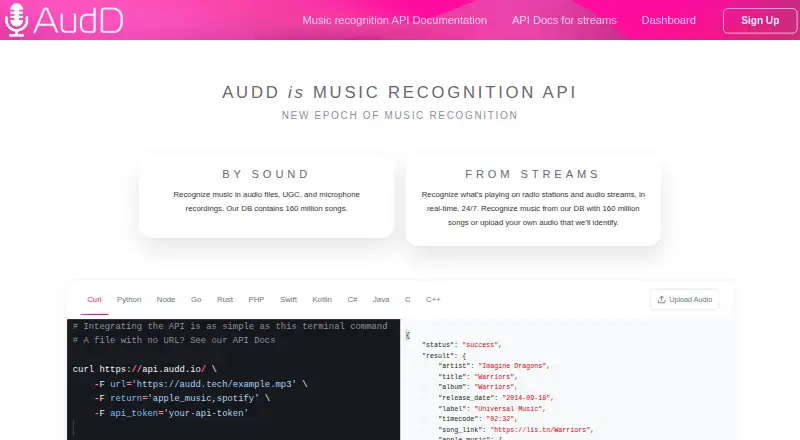
What AudD is
AudD identifies music in audio files, user-generated content, microphone recordings, streams, and video. It is available through a web interface, an API, and an extension. AudD says its catalog contains 160 million songs and uses its own neural-network audio fingerprinting technology. Results can include artist, title, album, label, release date, and identifiers such as ISRC and UPC; lyrics, listening links, and identification history are also listed. For continuous monitoring, AudD can watch radio stations and audio streams around the clock and return matches through webhooks or long polling. It can recognize music from Twitch, YouTube, and other stream URLs, and offers a Twitch extension and embeddable widget. The standard endpoint analyzes up to about 12 seconds per request, while the enterprise endpoint handles files of any length and returns recognized tracks with timestamps. AudD lists SDKs for Python, Node.js/TypeScript, Go, Rust, PHP, Swift, Kotlin, C#/.NET, Java, C, and C++, as well as an MCP server for AI agents. Signup includes 300 recognition requests without a credit card. File recognition pay-as-you-go costs $5 a month, billed at $5 per 1,000 requests. Stream recognition plans cost $25 a month for uploaded music or $45 a month for AudD’s catalog, each billed per stream. A volume plan costs $1,800 a month for 500,000 requests.
Who it suits
AudD suits developers adding music identification to apps or services, and teams that need to recognize tracks in recordings, video, or user-generated content. Its stream monitoring and enterprise endpoint also suit organizations processing continuous streams or longer files.
What it does well
- Recognizes music from files, recordings, streams, and video.
- Returns track metadata including artist, title, release date, ISRC, and UPC.
- Offers around-the-clock radio and audio stream monitoring.
- Enterprise endpoint processes files of any length with timestamps.
- Signup includes 300 recognition requests without a credit card.
- Lists SDKs for eleven programming languages and an MCP server.
What to know first
- Standard endpoint analyzes up to about 12 seconds per request.
- Stream monitoring plans are priced per stream per month.
- The 500,000-request volume plan costs $1,800 a month.
Limits
Signup includes 300 recognition requests. The standard endpoint handles up to about 12 seconds of audio per request; longer files require the enterprise endpoint. The listed volume plan covers 500,000 requests per month.
Plans
| Plan | Billed and limits | Price |
|---|---|---|
| Free trial | 300 requests total · usable for 14 days · no credit card · recognition stops at 300 | Free |
| File recognition volume plan | $1,800 per month · 500,000 requests per month | $1,800 a month |
| Stream monitoring with own catalog | $25 per stream per month · Uses uploaded catalog · catalog setup and storage fees quoted separately | $25 a month |
| Live stream recognition (uploaded music) | $25 per stream per month · Per stream · Your uploaded music catalog | $25 a month |
| Live stream recognition (AudD music database) | $45 per stream per month · Per stream · AudD music database | $45 a month |
| Stream monitoring with AudD database | $45 per stream per month · 24/7 stream recognition · billed by maximum simultaneous stream capacity | $45 a month |
| Startup | $450 per month · 100,000 requests/month · extra requests $4.50 per 1,000 | $450 a month |
| Indie | $5 per month · 1,000 requests/month · extra requests $5.00 per 1,000 · up to 90,000 requests/month listed tier | $5 a month |
The first 8 of 11 plans, as audd.io lists them, read 15 Oct 2026. The maker's own page has the final word. Every plan
Getting started
- Visit audd.io.
- Sign up to receive 300 recognition requests without providing a credit card.
- Choose file recognition, stream recognition, or a volume plan for your use case.
- Use the web interface, API, or extension on a supported platform.
- For stream monitoring, ask AudD about a trial.
Verdict
Choose AudD if you need music recognition through an API, web interface, or extension, or want to monitor streams continuously. The free signup requests provide a way to start with file recognition, while larger request volumes and stream monitoring have paid plans. Teams processing longer files need the enterprise endpoint.
Questions
Is there a free plan?
Yes. Signup includes 300 recognition requests without requiring a credit card.
How much does file recognition cost?
Pay-as-you-go file recognition is $5 a month, billed at $5 per 1,000 requests. A volume plan is $1,800 a month for 500,000 requests.
What does live stream recognition cost?
The uploaded music plan is $25 a month per stream. The AudD music database plan is $45 a month per stream.
Which platforms can I use?
AudD lists API, extension, and web access, with cross-platform support.
How long an audio file can the standard endpoint analyze?
It analyzes up to about 12 seconds per request. The enterprise endpoint accepts files of any length and returns track timestamps.
Does AudD offer on-premise deployment?
Yes. AudD says on-premise deployment is available for audio that cannot leave a customer’s environment.
Facts from AudD's own pages
- Android availability
- The former AudD Android app was removed from Google Play after version 1.0 and is currently unavailable. · appbrain.com, 15 Oct 2026
- API authentication
- All API requests require an account token supplied as the api_token parameter. · docs.audd.io, 15 Oct 2026
- API limits
- The standard endpoint has no documented rate limit, while the enterprise endpoint has a default concurrent-request limit that AudD can raise. · docs.audd.io, 15 Oct 2026
- Chrome extension reach
- The Chrome Web Store listing reports about 40,000 users and links to the extension's public source repository. · chromewebstore.google.com, 15 Oct 2026
- Company facts
- LinkedIn lists AudD as a privately held IT system data-services company founded in 2018 with 2–10 employees. · linkedin.com, 15 Oct 2026
- Custom catalog
- Accounts with special access can upload private tracks so later recognition matches against that account-specific catalog. · github.com, 15 Oct 2026
- Documentation depth
- The public documentation includes endpoint parameters, response schemas, curl examples and language-specific examples for every public endpoint. · docs.audd.io, 15 Oct 2026
- Enterprise endpoint
- The enterprise endpoint accepts audio or video files of unlimited length and returns multiple tracks with timestamps. · audd.io, 15 Oct 2026
- Enterprise privacy
- AudD says enterprise clients can sign a data processing agreement, and on-premise deployment is available for audio that cannot leave a customer's environment. · audd.io, 7 Oct 2026
- Free usage
- AudD provides 300 recognition requests at signup without requiring a credit card. · audd.io, 7 Oct 2026
- Large-file capability
- The enterprise endpoint processes files of any length and returns recognized tracks with timestamps. · audd.io, 7 Oct 2026
- Legal entity
- AudD identifies AudD, LLC, a Delaware limited liability company, as one contracting entity and lists Dover, Delaware as its address. · audd.io, 15 Oct 2026
- License
- AudD's public SDK repositories and OpenAPI specification are released under the MIT license, while the hosted recognition service is proprietary. · github.com, 15 Oct 2026
- Limit: payment and token friction
- Some extension users report paid-plan requirements, trial limits and authorization or token-saving errors. · chrome-stats.com, 15 Oct 2026
- Limit: recognition reliability
- Chrome extension reviewers also report wrong matches, failures to identify songs and occasional results that do not display correctly. · chrome-stats.com, 15 Oct 2026
- MCP support
- AudD provides an MCP server intended to let AI agents search documentation, inspect usage and make API calls. · audd.io, 15 Oct 2026
- Metadata
- Recognition responses can include artist, title, album, release date, label, timecode, song links and provider metadata. · docs.audd.io, 15 Oct 2026
- Music recognition
- AudD identifies music in audio files, user generated content, microphone recordings, streams, and video. · audd.io, 7 Oct 2026
- Notable news: 2026 accuracy test
- AudD says its latest comparison test, run May 10, 2026, showed more than a four-point absolute AUC lead over two competitors. · audd.io, 15 Oct 2026
- Official SDKs
- Official SDKs are documented for Python, Node.js/TypeScript, Go, Rust, PHP, Swift, Kotlin, C#/.NET, Java, C and C++. · docs.audd.io, 15 Oct 2026
- Praise: Chrome extension users
- Independent extension reviews often mention fast identification, success with very short or obscure clips and useful streaming links. · chrome-stats.com, 15 Oct 2026
- Praise: Trustpilot reviewers
- Reviewers repeatedly praise recognition accuracy, straightforward documentation, responsive support and affordable pricing. · trustpilot.com, 15 Oct 2026
- Privacy option
- Enterprise customers can sign a data-processing agreement or deploy the recognition technology on premises so audio stays inside their environment. · audd.io, 15 Oct 2026
- Provider integrations
- The API can attach Apple Music, Spotify, Deezer, Napster and MusicBrainz identifiers or links when requested. · github.com, 15 Oct 2026
Where AudD stands on Freedom251
- Music Identification Apps#15 of 23