Freedom251 › Digital Risk Protection Software

Allure Brand Protection
What Allure Brand Protection is
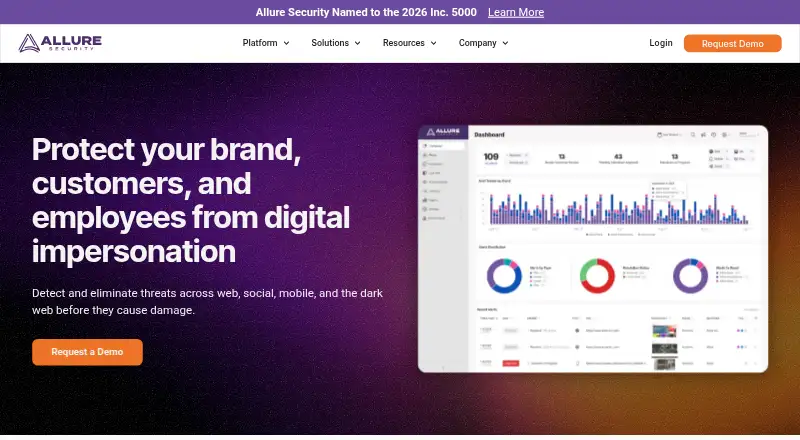
Allure Brand Protection monitors external channels for digital impersonation threats, validates alerts, and coordinates removal through a managed 24/7 Security Operations Center. Its coverage can include websites and domains, social media, mobile apps, dark web exposure, executive impersonation, and paid advertising abuse; the surfaces included depend on the plan. Allure says the platform monitors over 1.5 billion URLs daily, with a median of about 15 minutes from detection to blocking. The vendor also says analyst validation keeps false positives under 1%, and lists unlimited takedown capacity. Alerts can reach existing tools through API, email, Slack, or Teams. Its dashboard captures screenshots, timestamps, and chain-of-custody details, while the Alert Timeline supports audit trails and reporting. The product is available on web and through an API, with dark web monitoring, credential leak alerts, impersonation monitoring, and takedown workflows. Pricing is on request; Allure describes flat-rate pricing without per-incident fees or takedown limits. The company says it grew from DARPA-funded research at Columbia University.
Who it suits
It is presented for security and IT, fraud and risk, marketing, customer support, legal and compliance, and executive leadership teams. Organizations should confirm which threat surfaces are included in their plan.
What it does well
- Managed 24/7 detection, validation, and takedown
- Coverage can span web, social, mobile, and dark web
- Alerts integrate through API, email, Slack, or Teams
- Dashboard records screenshots, timestamps, and chain of custody
What to know first
- Pricing is available on request
- Threat surfaces included vary by plan
Limits
Threat surfaces included in a package vary by plan and organizational needs. Allure lists unlimited takedown capacity and no per-incident fees or takedown limits.
Plans
| Plan | Billed and limits | Price |
|---|---|---|
| Allure Brand Protection | Flat-rate pricing · no per-incident fees or takedown limits · coverage varies by plan and organization needs | On request |
As alluresecurity.com lists them, read 4 Oct 2026. The maker's own page has the final word.
Getting started
- Visit the Allure Security website
- Contact Allure to discuss coverage for your organization
- Choose the threat surfaces and plan coverage that fit your needs
- Connect alerts to existing tools through API, email, Slack, or Teams
Allure Brand Protection is a digital impersonation monitoring and response service for organizations protecting brands, executives, and customers across external channels. It best suits teams that want a managed 24/7 operation to validate threats and pursue removals. Its strongest advantage is that response is part of the service; the trade-off is custom pricing and coverage that depends on the package.
Overview
Allure combines monitoring with a Security Operations Center that handles detection, validation, and takedown through confirmed removal. That makes it a better fit for organizations that need operational follow-through than for buyers seeking alerts alone. The vendor says it monitors over 1.5 billion URLs daily, reports a median detection-to-blocking time of about 15 minutes, and keeps false positives under 1% through analyst validation. Those vendor-reported measures describe a service aimed at rapid, reviewed action.
Threat coverage spans web and domains, social media, mobile apps, dark web exposure, executive impersonation, and paid advertising abuse. This breadth could bring several monitoring needs into one service, but buyers should confirm which surfaces their package includes before committing.
Key features
- Managed takedown: The 24/7 SOC validates threats and pursues removal, while the managed service describes unlimited takedown capacity. That is valuable for teams without staff to manage each case, though it does not remove the need to confirm package coverage.
- Multiple threat surfaces: Monitoring includes brand impersonation across web, social, mobile apps, dark web exposure, executive impersonation, and advertising abuse. Organizations with varied exposure may benefit from the range; teams with a narrow need may find a broader managed service unnecessary.
- Evidence and reporting: The dashboard records screenshots, timestamps, and chain of custody; the managed service also describes audit trails and an Alert Timeline. These records support investigation and compliance workflows.
- Integrations and blocking partners: Alerts can reach existing tools through API, email, Slack, or Teams. Named blocklist partners include Google Safe Browsing, OpenPhish, Spamhaus, APWG eCX, and CleanDNS, giving teams several established destinations for threat indicators.
- Brand-protection essentials: The plan includes dark web monitoring, credential leak alerts, impersonation monitoring, takedown workflows, and API access. Allure says it grew out of DARPA-funded research at Columbia University, a relevant part of its company background rather than a substitute for evaluating service fit.
Pricing
Allure Brand Protection uses custom pricing. The vendor describes flat-rate pricing with no per-incident fees or takedown limits, which can make incident volume less of a billing concern than in a per-case model. Coverage varies by plan and organizational needs, so buyers should establish the surfaces and service scope included in a quote. No free plan or trial is stated.
Platforms
Allure supports web and API access. The API, email, Slack, and Teams alert routes can fit into existing security workflows; the core service also includes a dashboard for evidence and reporting.
Who it's for
Allure is aimed at security and IT, fraud and risk, marketing, customer support, legal and compliance, and executive leadership teams. It is most compelling for organizations that need several of those functions to coordinate around external impersonation threats and want managed validation and removal. Buyers needing only a single monitoring surface or a self-service tool should compare narrower options before paying for managed coverage.
Pros and cons
Pros
- Response through confirmed removal: The SOC handles validation and takedown, reducing the operational burden on internal teams.
- Broad channel coverage: Web, social, mobile, dark web, executive impersonation, and ad abuse are within the service's stated scope.
- Unlimited managed takedowns: The service describes no takedown capacity limit, avoiding a stated annual case quota.
- Useful evidence trail: Screenshots, timestamps, chain of custody, audit trails, and an Alert Timeline support review and reporting.
Cons
- Custom pricing: Buyers cannot compare a published price without engaging the vendor.
- Package-dependent coverage: Included threat surfaces vary, so broad stated coverage does not guarantee every surface in a particular package.
- Managed-service orientation: Teams that only need alerts or want to run takedowns themselves may not need the SOC-led workflow.
Alternatives
Compare digital risk protection software if you want to review the wider category. Consider CTM360 if a freemium option and an ongoing free Community Edition for one authorized user matter; its Restricted External Attack Surface Management plan is 5000.00 USD. Choose PhishEye if a free starting point is more important: its Free plan monitors one brand and runs one typosquat scan, with 30-day scan history but no takedown cases or requests. Styx Platform is an alternative to evaluate if a free Basic plan with stated domain, brand, executive, vendor, and annual takedown limits suits your needs. Consider Memcyco Digital Risk Protection for a paid option with a free demo. Seqrite Digital Risk Protection Service offers a plan tailored to organizational requirements. SOCRadar Extended Threat Intelligence Platform is worth comparing if you want freemium access or published monthly dark web monitoring plans, including an Essential plan at $600 a month for one domain and one seat. Axur Platform offers a custom platform demo with pricing and bundles tailored to customer needs. Bolster Automated Digital Risk Protection is another paid option with custom packages and a free plan.
Verdict
Choose Allure if your organization needs broad impersonation monitoring backed by round-the-clock validation and managed takedowns, particularly when internal teams cannot own removals. The combination of wide threat coverage, evidence records, and no stated managed takedown limit is its clearest case. Look elsewhere if published pricing, a free starting tier, or control over a narrowly scoped self-service workflow matters more.
Verdict
Allure combines broad impersonation monitoring with managed validation and takedown workflows. Its coverage details and pricing require a conversation with the vendor.
Questions
How much does Allure Brand Protection cost?
Pricing is on request. The plan is described as flat-rate, with no per-incident fees.
What channels can it monitor?
Coverage can include web and domains, social media, mobile apps, dark web exposure, executive impersonation, and paid advertising abuse. Included surfaces vary by plan and organizational needs.
Does the service handle takedowns?
Yes. Its 24/7 Security Operations Center handles detection, validation, and takedown through confirmed removal. Takedown capacity is listed as unlimited.
How can alerts reach other tools?
Alerts can flow through API, email, Slack, or Teams.
What evidence and reporting are available?
The dashboard records screenshots, timestamps, and chain-of-custody details. Audit trails and reporting are available through an Alert Timeline.
Who makes Allure Brand Protection?
Allure Security was founded in 2009 and is headquartered in Watertown, Connecticut. The company grew out of DARPA-funded research at Columbia University.
Facts from Allure Brand Protection's own pages
- Alert integrations
- Alerts can flow to existing tools via API, email, Slack, or Teams. · alluresecurity.com, 4 Oct 2026
- Blocking speed
- The vendor reports a median time from detection to blocking of about 15 minutes. · alluresecurity.com, 4 Oct 2026
- Blocklist partners
- Named blocklist partners include Google Safe Browsing, OpenPhish, Spamhaus, APWG eCX, and CleanDNS. · alluresecurity.com, 4 Oct 2026
- Company background
- Allure Security says it grew out of DARPA-funded research at Columbia University. · alluresecurity.com, 4 Oct 2026
- Coverage limits
- Threat surfaces included in a package vary by plan, and the vendor asks customers to contact it about coverage. · alluresecurity.com, 4 Oct 2026
- Detection scale
- The platform says it monitors over 1.5 billion URLs daily. · alluresecurity.com, 4 Oct 2026
- Evidence and reporting
- The dashboard records screenshots, timestamps, and chain of custody, and the managed service describes audit trails and reporting through an Alert Timeline. · alluresecurity.com, 4 Oct 2026
- False positives
- The vendor says analyst validation keeps false positives under 1%. · alluresecurity.com, 4 Oct 2026
- Founded
- 2009 · alluresecurity.com, 28 Sept 2026
- Headquarters
- The About page image caption describes the team as based in Boston. · alluresecurity.com, 4 Oct 2026
- Intended customers
- The platform describes use by security and IT, fraud and risk, marketing, customer support, legal and compliance, and executive leadership teams. · alluresecurity.com, 4 Oct 2026
- Managed service
- Its 24/7 Security Operations Center handles detection, validation, and takedown through confirmed removal. · alluresecurity.com, 4 Oct 2026
- Purpose
- Allure detects, validates, and eliminates digital impersonation threats across external channels. · alluresecurity.com, 4 Oct 2026
- Takedown capacity
- The managed service page lists unlimited takedown capacity. · alluresecurity.com, 4 Oct 2026
- Threat coverage
- Coverage includes web and domains, social media, mobile apps, dark web exposure, executive impersonation, and paid advertising abuse. · alluresecurity.com, 4 Oct 2026
Where Allure Brand Protection stands on Freedom251
- Digital Risk Protection Software#9 of 26