Freedom251 › Honeypot Software
ADBHoney
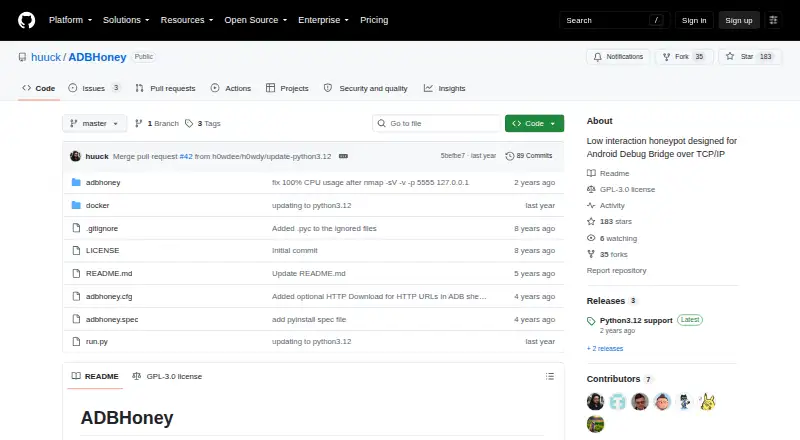
What ADBHoney is
ADBHoney is a self-hosted, low-interaction honeypot for investigating activity directed at exposed Android Debug Bridge services. It is designed to catch malware pushed to devices over ADB on TCP/IP, including devices with port 5555 exposed. The decoy accepts ADB connection, file-upload, and shell operations, so it can record attempts to connect, push files, or issue commands. Captured data is redirected to standard output, while uploaded files are written to disk.
Its simulated shell is deliberately narrow: `adb shell ls` gets a distinct response, whereas other commands return `command not found`. Native directory listing and interactive shell sessions are outside its supported scope. Configuration comes from `adbhoney.cfg`, placed beside `run.py` or at `/etc/adbhoney.cfg`. The project README describes launching the Python script or building and running a Docker container, and characterizes CPU and memory use as fairly low. The repository identifies the software as GPL-3.0 open source. Its GitHub profile identifies huuck as Gabriel Cirlig. For protocol-behavior issues, the maintainer requests a `.pcap` capture or highly precise reproduction steps.
Who it suits
ADBHoney suits people investigating activity against exposed Android Debug Bridge services, especially attempts to push malware to reachable devices. It is for operators able to deploy a self-hosted endpoint decoy and work within its limited shell simulation.
What it does well
- Accepts ADB connect, push, and shell operations.
- Sends captured data to stdout and saves uploaded files to disk.
- Offers Python-script and Docker deployment routes.
- GPL-3.0 open-source license.
- README characterizes CPU and memory use as fairly low.
What to know first
- Only `adb shell ls` receives a unique shell response.
- Native directory listing and interactive shell are unsupported.
- Requires self-hosted deployment and configuration file placement.
Limits
The shell simulation gives a unique response only to `adb shell ls`; other commands return `command not found`. Native directory listing and interactive shell sessions are not supported.
Getting started
- Open the ADBHoney GitHub project page.
- Choose to run the Python script or build and run a Docker container.
- Place `adbhoney.cfg` beside `run.py` or at `/etc/adbhoney.cfg`.
- Run the deployment and observe captured data on stdout and uploaded files on disk.
Verdict
Choose ADBHoney to observe connection, upload, and command activity against exposed ADB endpoints with a focused honeypot. Look elsewhere if the task requires native directory listing, a broad set of shell commands, or interactive shell behavior.
Questions
What does ADBHoney do?
It is a low-interaction honeypot intended to catch malware pushed to devices with Android Debug Bridge exposed over TCP/IP.
What ADB activity does it accept?
It accepts ADB connect, push, and shell operations.
Where does captured data go?
Data is redirected to stdout, and uploaded files are saved to disk.
How can it be deployed?
The project README describes running the Python script or building and running a Docker container.
Is ADBHoney open source?
Yes. The repository identifies its license as GPL-3.0.
Who maintains the project?
The GitHub profile identifies huuck as Gabriel Cirlig.
Facts from ADBHoney's own pages
- ADB commands
- It supports connecting with adb connect, uploading with adb push, and running commands with adb shell. · github.com, 8 Oct 2026
- Captured data
- Data is redirected to stdout and uploaded files are saved to disk. · github.com, 4 Oct 2026
- Configuration
- The configuration file must be beside run.py or at /etc/adbhoney.cfg. · github.com, 8 Oct 2026
- Deployment
- The project can be started with Python or run using Docker or Docker Compose. · github.com, 8 Oct 2026
- Intended users
- The README describes the project for investigating activity against exposed Android Debug Bridge services. · github.com, 8 Oct 2026
- Issue reports
- The maintainer asks for a .pcap or very exact reproduction steps when reporting protocol issues. · github.com, 8 Oct 2026
- License
- The GitHub repository identifies the project as GPL-3.0 licensed. · github.com, 8 Oct 2026
- Limitations
- More advanced commands, including native directory listing and an interactive shell, are not supported. · github.com, 8 Oct 2026
- Logging
- Data is redirected to stdout, and files are saved to disk. · github.com, 8 Oct 2026
- Maker
- The GitHub profile identifies huuck as Gabriel Cirlig. · github.com, 4 Oct 2026
- Protocol
- It accepts ADB connect, push, and shell operations. · github.com, 4 Oct 2026
- Purpose
- ADBHoney is a low interaction honeypot designed for Android Debug Bridge over TCP/IP. · github.com, 8 Oct 2026
- Resource use
- The README says CPU and memory usage should be fairly low. · github.com, 8 Oct 2026
- Shell responses
- The adb shell ls command has a unique response; other commands respond with command not found unless responses are added in responses.py. · github.com, 8 Oct 2026
- Support
- For issues involving protocol behavior, the maintainer asks for a `.pcap` or very exact reproduction steps. · github.com, 4 Oct 2026
- Use case
- The project aims to catch malware pushed by attackers to devices with port 5555 exposed. · github.com, 8 Oct 2026
Where ADBHoney stands on Freedom251
- Honeypot Software#17 of 21