Freedom251 › Student Response Systems

Acadly
What Acadly is
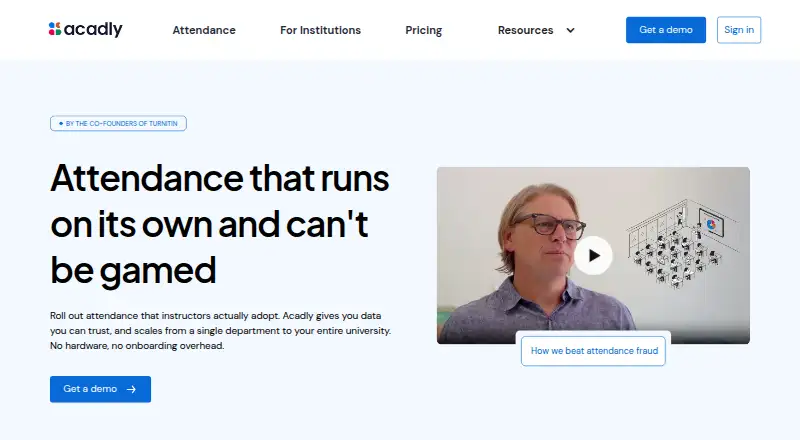
Acadly combines automated class attendance with tools for engaging students during class. Instructors can configure a roster, schedule, and attendance rules once so sessions run automatically. Acadly says its mesh-network technology checks physical presence without GPS or QR codes, does not track geolocation, and flags suspicious patterns for instructor review. For participation, it supports live polls, quizzes, word clouds, discussions, Q&A, and a class backchannel that instructors and teaching assistants can monitor. A native PowerPoint add-in can launch attendance and polls from slides and is described as working on Mac and PC. Institutional deployments support LTI compatibility with Moodle, Brightspace, Blackboard, and Canvas, along with Zoom and PowerPoint integrations. Acadly is aimed at higher-education instructors and institutions; Acadly Here is presented for groups such as teams, bands, K-12 programs, and congregations. The listed platforms are Android, iOS, macOS, and web. Basic is listed at $3 a month billed, with teacher-pays pricing of $3 per course or student-pays pricing of $5 per course. Pro is $5 a month billed, with teacher-pays pricing of $5 per course or student-pays pricing of $10 per course. A First Course Free option covers one course for up to five months. Institutional plans add options such as LMS plugins, roster syncing, and fraud alerts.
Who it suits
Acadly suits higher-education instructors who want attendance automation alongside polls, quizzes, Q&A, and class discussions. Institutions can consider its institutional deployment, while Acadly Here is presented for groups including teams, bands, K-12 programs, and congregations.
What it does well
- Automates attendance after instructors configure the roster, schedule, and rules.
- Verifies physical presence without GPS or QR codes.
- Includes live polls, quizzes, word clouds, discussions, and Q&A.
- PowerPoint add-in can launch attendance and polls from slides.
- Institutional deployments support LTI with four named learning platforms.
What to know first
- Fraud alerts, LMS and SSO integration, and bulk course setup are institutional features.
- The First Course Free option excludes fraud alerts.
- Acadly Basic Course excludes PowerPoint polling and Zoom integration.
Limits
First Course Free covers one course for up to five months and excludes fraud alerts. Acadly Basic Course excludes PowerPoint polling and Zoom integration, while fraud alerts and LMS/SSO are excluded from the listed individual course options.
Plans
| Plan | Billed and limits | Price |
|---|---|---|
| Basic | Student-pays model is shown as $5 per course; teacher-pays model is shown as $3 per course. · In-person attendance automation · Polls and word clouds · Multiple-choice and true/false quizzes · Backchannels · Basic data exports · Q&A | $3 a month |
| Pro | Student-pays model is shown as $10 per course; teacher-pays model is shown as $5 per course. · Everything in Basic · Scheduled automatic attendance · Anonymous Q&A · Sorting-type quizzes · Zoom integration · Online attendance automation | $5 a month |
| Enterprise | LMS plugin for instructors · LMS plugin for administrators · Automatic course provisioning · Roster syncing · Contact tracing · Premium support | On request |
| Enterprise | LMS plugin for instructors · LMS plugin for administrators · Automatic course provisioning · Roster syncing · Contact tracing · Premium support | On request |
| First Course Free | First course, up to five months · PowerPoint integration · scheduled attendance · web and app · fraud alerts excluded | Free |
| Acadly Basic Course | Per course; students pay $3 or instructor pays $1.5/student · App-only instructor-initiated attendance · CSV names only · no PowerPoint polling or Zoom integration · LMS and SSO unavailable | $3, paid once |
| Acadly Pro Course | Per course; students pay $5 or instructor pays $2/student · Scheduled attendance · PowerPoint, web and app attendance · PowerPoint polling · Zoom integration · CSV includes student emails · fraud alerts and LMS/SSO excluded | $5, paid once |
| Institutional | Annual or multi-year contract; quote based on active student users, integrations, services and custom requirements · No hardware cost · no limit on courses or instructors · fraud alerts · LMS and SSO integration · done-for-you course setup | On request |
The first 8 of 9 plans, as acadly.com lists them, read 22 Sept 2026. The maker's own page has the final word. Every plan
Getting started
- Visit acadly.com.
- Choose the Basic or Pro course option, or use the First Course Free option for one course.
- Access Acadly through the web app or its Android or iOS app listings.
- Configure the course roster, schedule, and attendance rules.
- For slide-based attendance and polling, use the native PowerPoint add-in on Mac or PC.
- Contact Acadly for an institution-focused demo or structured pilot.
Acadly brings attendance automation and live classroom participation into one platform, with course plans for instructors and a separate institutional offering. Its strongest fit is a higher-education instructor who wants attendance and polling, quizzes or Q&A to work together; the trade-off is that key campus controls sit behind institutional pricing.
Overview
Acadly pairs attendance tools with polls, quizzes, word clouds, discussions and a class backchannel that instructors and teaching assistants can monitor. Acadly Here adapts attendance for groups outside higher education, including teams, bands, K-12 programs and congregations. The range is useful for teaching settings where attendance and participation are connected, but buyers should distinguish the individual course plans from institution-level administration and integrations.
Key features
Instructors can set a roster, schedule and attendance rules once so sessions run automatically. Acadly says its mesh-network technology verifies physical presence without GPS or QR codes, and that it does not track geolocation. That is a relevant distinction for classes concerned about location tracking. Fraud alerts for suspicious attendance patterns, however, are an institutional feature; individual buyers do not get that review aid.
Live polls, quizzes, word clouds, discussions, Q&A and a monitored backchannel give instructors several ways to invite participation. Anonymous Q&A is included in Pro, while the Basic course plan includes Q&A without the anonymous option. The native PowerPoint add-in can launch attendance and polls from slides on Mac and PC, keeping those activities alongside the teaching material. Zoom integration is included in Pro and supported in institutional deployments.
Institutions can connect Acadly through LTI with Moodle, Brightspace, Blackboard and Canvas, alongside Zoom and PowerPoint integrations. LMS and SSO integration, fraud alerts and bulk course setup are institutional features rather than individual-plan features. Acadly says HECVAT and VPAT documentation is available and describes FERPA and GDPR compliance under an enterprise agreement. It also says institutional data can be exported in standard formats at any time and is not retained beyond that agreement. Institution-focused demos and structured pilots include onboarding support.
Pricing
Acadly offers both per-course and monthly plan structures, with student-pays and teacher-pays models on several course options. The plan labels and billing terms matter: compare the per-course options with the monthly Basic and Pro plans rather than treating their displayed amounts as interchangeable.
- First Course Free: free for the first course, for up to five months. It includes PowerPoint integration, scheduled attendance, web and app access; fraud alerts are excluded. This is a useful way to cover an initial course, but it does not provide the institutional fraud-alert feature.
- Acadly Basic Course: $3, paid once, billed per course; students pay $3 or the instructor pays $1.5/student. It covers app-only, instructor-initiated attendance, CSV exports with names only, and excludes PowerPoint polling, Zoom, LMS and SSO. This is the lower-cost choice for a course that needs basic attendance but not scheduled automation or slide-based polling.
- Acadly Pro Course: $5, paid once, billed per course; students pay $5 or the instructor pays $2/student. It adds scheduled attendance, PowerPoint, web and app attendance, PowerPoint polling, Zoom integration and CSV exports with student emails. Fraud alerts and LMS/SSO remain excluded, so it suits an individual course needing a fuller classroom workflow, not campus-level administration.
- Basic: $3 a month, billed, with a student-pays model shown as $5 per course and a teacher-pays model shown as $3 per course. It includes in-person attendance automation, polls and word clouds, multiple-choice and true/false quizzes, backchannels, basic data exports and Q&A. It lacks the scheduled automatic attendance and Zoom integration of Pro.
- Pro: $5 a month, billed, with a student-pays model shown as $10 per course and a teacher-pays model shown as $5 per course. It includes everything in Basic plus scheduled automatic attendance, anonymous Q&A, sorting-type quizzes, Zoom integration and online attendance automation. Choose it when those additions justify the higher plan price.
- Enterprise: custom pricing. It includes LMS plugins for instructors and administrators, automatic course provisioning, roster syncing, contact tracing and premium support. It is the relevant route for institutional setup rather than an individual instructor’s course.
- Institutional: custom pricing under an annual or multi-year contract, quoted according to active student users, integrations, services and custom requirements. It includes no hardware cost, no limit on courses or instructors, fraud alerts, LMS and SSO integration, and done-for-you course setup. Those campus features come with a contract commitment.
- Acadly Here: custom pricing, with in-app subscriptions between $15 and $75 per month depending on group size and duration. It offers standalone attendance, app-initiated attendance and CSV exports for groups outside higher education.
Platforms
Acadly is available on Android, iOS, macOS and the web. The PowerPoint add-in works on Mac and PC, giving instructors another option for launching attendance and polls from presentation slides.
Who it's for
Acadly is a strong fit for higher-education instructors who want automated attendance alongside live participation tools, especially when scheduled attendance or PowerPoint polling matters. Institutions needing roster syncing, LMS or SSO connectivity, fraud alerts or bulk setup should consider the institutional offering. Groups outside higher education may find Acadly Here’s standalone attendance more relevant than the classroom plans.
Pros and cons
- Pro: Attendance rules can be configured in advance so sessions run automatically, reducing repeated setup across classes.
- Pro: Mesh-network verification is presented as checking physical presence without GPS or QR codes, and without geolocation tracking.
- Pro: Polls, quizzes, Q&A and a monitored backchannel combine attendance with multiple participation formats.
- Con: Fraud alerts and LMS/SSO integration require institutional deployment, limiting what individual course buyers can do.
- Con: The Basic Course option excludes PowerPoint polling and Zoom, and its attendance is app-only and instructor-initiated.
- Con: The free first course excludes fraud alerts and lasts up to five months, so it is a bounded starting point rather than an institutional substitute.
Alternatives
For a broader comparison of classroom response tools, see Student Response Systems and Audience Response Systems.
- Poll Everywhere is worth considering when a free plan with a stated audience cap is the priority: its Intro plan supports 40 audience members, or 700 for 30 days.
- iClicker may suit instructors focused on attendance tracking, auto-run class sessions and late-arrival tracking through its Pulse plans.
- Particify is an option for those who want a free plan allowing 200 participants per room, unlimited rooms and unlimited question series.
- Wayground (formerly Quizizz) may be preferable when a free activity plan with up to 100 participants per session is enough.
- AhaSlides offers a free plan for up to 50 participants, with limits of five quiz questions and three poll questions.
- Kahoot! offers a free Go plan for up to 40 participants with quiz and true/false question types.
- Open Response is a free, open-source classroom polling option.
- ARSnova offers a free plan for up to 500 participants without sign-up.
Verdict
Choose Acadly if you teach higher education and want attendance automation tied to polls, quizzes and Q&A, especially with scheduled attendance or PowerPoint polling. Its individual course plans cover that combined workflow, while institutions gain deeper administration and integrations through custom-priced contracts. Look elsewhere if your course requires fraud alerts, LMS or SSO integration, or bulk setup without an institutional deployment.
Verdict
Choose Acadly if course attendance and live classroom participation need to work together, especially when instructors want scheduled attendance or slide-based polling. Institutions needing fraud alerts, LMS or SSO integration, or bulk course setup should look at the institutional offering. The First Course Free option can cover an initial course for up to five months.
Questions
Does Acadly have a free option?
Yes. First Course Free covers one course for up to five months; fraud alerts are excluded.
How much do Basic and Pro cost?
Basic is listed at $3 a month billed, with teacher-pays pricing of $3 per course or student-pays pricing of $5 per course. Pro is listed at $5 a month billed, with teacher-pays pricing of $5 per course or student-pays pricing of $10 per course.
Which platforms does Acadly support?
Acadly lists Android, iOS, macOS, and web. Its site describes access through a web app, and its mobile apps are listed in the Apple App Store and Google Play.
Which learning platforms integrate with institutional Acadly deployments?
Institutional deployments support LTI compatibility with Moodle, Brightspace, Blackboard, and Canvas. They also support Zoom and PowerPoint integrations.
Does Acadly track location for attendance?
Acadly says its mesh-network attendance verification does not track geolocation and works without GPS or QR codes.
What does the institutional offering include?
Listed features include LMS plugins for instructors and administrators, automatic course provisioning, roster syncing, contact tracing, and premium support. Institutional pricing is an annual or multi-year contract quoted based on active student users, integrations, services, and custom requirements.
Facts from Acadly's own pages
- Anonymous responses
- Yes · acadly.com, 22 Sept 2026
- Attendance automation
- Instructors can configure the roster, schedule and attendance rules once so sessions run automatically. · acadly.com, 11 Oct 2026
- Attendance verification
- Acadly says its mesh-network technology verifies physical presence without GPS or QR codes and flags suspicious patterns for instructor review. · acadly.com, 11 Oct 2026
- Company address
- Acadly Inc lists its address as 8 The Green STE A, Dover, Delaware 19901, United States. · acadly.com, 11 Oct 2026
- Compliance
- Acadly says HECVAT and VPAT documentation are available and describes FERPA and GDPR compliance under an enterprise agreement. · acadly.com, 11 Oct 2026
- Data export and retention
- The maker says institutional data can be exported at any time in standard formats and is not retained beyond the enterprise agreement. · acadly.com, 11 Oct 2026
- Engagement features
- The platform supports live polls, quizzes, word clouds, discussions and a class backchannel that instructors and teaching assistants can monitor. · acadly.com, 11 Oct 2026
- Free plan
- No · acadly.com, 22 Sept 2026
- Institutional limits
- Fraud alerts, LMS and SSO integration, and bulk course setup are institutional features rather than individual-plan features. · acadly.com, 11 Oct 2026
- Integrations
- Institutional deployments support LTI compatibility with Moodle, Brightspace, Blackboard and Canvas, plus Zoom and PowerPoint integrations. · acadly.com, 11 Oct 2026
- Intended users
- Acadly is aimed at higher-education instructors and institutions, while Acadly Here is presented for groups such as teams, bands, K-12 programs and congregations. · acadly.com, 11 Oct 2026
- Live polling
- Yes · acadly.com, 22 Sept 2026
- Live Q&A
- Yes · acadly.com, 22 Sept 2026
- Mobile availability
- Acadly has listings in the Apple App Store and Google Play; its site also describes access through a web app. · apps.apple.com, 11 Oct 2026
- PowerPoint
- The native PowerPoint add-in can launch attendance and polls from slides, and the maker says it works on Mac and PC. · acadly.com, 11 Oct 2026
- Privacy
- Acadly states that its attendance verification does not track geolocation. · acadly.com, 11 Oct 2026
- Product
- Acadly automates class attendance and offers tools for in-class engagement, including polls, quizzes, word clouds and discussions. · acadly.com, 11 Oct 2026
- Quiz mode
- Yes · acadly.com, 22 Sept 2026
- Slide integrations
- Yes · acadly.com, 22 Sept 2026
- Support
- Acadly lists support at [email protected] and offers institution-focused demos and structured pilots with onboarding support. · acadly.com, 11 Oct 2026
Where Acadly stands on Freedom251
- Student Response Systems#2 of 45
- Audience Response Systems#14 of 118