Some links on this page are affiliate links: if you buy through them we may earn a commission, at no extra cost to you.
MSI has added three AM5 motherboards to its X870E and X870 lineup: the flagship MEG X870E ACE MAX, the compact MPG X870I EDGE TI EVO WIFI, and the more affordable PRO X870E-S EVO WIFI. MSI announced the models in Japan on February 6, 2026, with sales scheduled to begin February 13.
The lineup covers three distinct buyers rather than three interchangeable boards: the ACE MAX targets high-end expansion and overclocking, the MPG X870I is designed for premium Mini-ITX systems, and the PRO X870E-S is the value-oriented ATX option.
The three new MSI motherboards at a glance
| Model | Chipset | Form factor | Best suited to | Japanese launch price |
|---|---|---|---|---|
| MEG X870E ACE MAX | X870E | ATX | Enthusiast builds, multi-drive workstations and serious tuning | ¥139,800, tax included |
| MPG X870I EDGE TI EVO WIFI | X870 | Mini-ITX | Premium compact and white-themed systems | ¥62,980, tax included |
| PRO X870E-S EVO WIFI | X870E | ATX | General-purpose, professional and value-focused builds | ¥39,980, tax included |
The prices above are Japanese launch prices and should not be treated as US MSRPs or direct currency conversions. The MSI US Store currently lists the MEG X870E ACE MAX at $699.99, but the available evidence does not establish US launch pricing or US availability for the other two models.
MEG X870E ACE MAX: MSI’s flagship AM5 board
The MEG X870E ACE MAX is an ATX motherboard for AMD’s AM5 socket. MSI lists support for Ryzen 9000, Ryzen 8000 and Ryzen 7000 desktop processors, with four DDR5 UDIMM slots supporting up to 256GB of memory.
#1 Best Overall

- ULTRA POWER+ - SUPPORTS THE LATEST RYZEN 9000 PROCESSORS IN HIGH PERFORMANCE - The MEG X870E ACE MAX employs a 18 Duet Rail Power Phase with 110A SPS for the AMD X870E chipset (AM5, Ryzen 9000 / 8000 / 7000) with Core Boost architecture
- FROZR GUARD - Premium cooling features such as Wavy fin design, Direct-touch Cross Heat-pipe, 9W/mK MOSFET thermal pads, extra choke thermal pads, double-sided EZ M.2 Shield Frozr II, and Combo-fan (for pump & system) header (3A)
- DDR5 MEMORY, PCIe 5.0 x16 SLOTS - 4 x DDR5 DIMM SMT slots enable extreme memory overclocking speeds (1DPC 1R, up to 9000+ MT/s OC); 1 x PCIe 5.0 x16 SMT slot (128GB/s) with Steel Armor II supports cutting-edge graphics cards
- QUINTUPLE M.2 CONNECTORS - Storage options include 2 x M.2 Gen5 x4 128Gbps slots, 3 x M.2 Gen4 x4 64Gbps slots with EZ M.2 Shield Frozr II to prevent thermal throttling
- ULTRA CONNECT - Network hardware includes a full-speed Wi-Fi 7 with Bluetooth 5.4 & 10Gbps plus 5Gbps LAN; Rear ports include USB4 Type-C 40Gbps with display output and 7.1 USB High Performance Audio with Audio Boost 5 HD (supports S/PDIF output)
Its advertised memory range extends from DDR5-5600 to DDR5-9000, depending on the processor, BIOS, DIMM population and overclocking configuration. DDR5-9000 is therefore an overclocked ceiling, not a guaranteed plug-and-play operating speed. Buyers should check MSI’s memory QVL and specification page before choosing a high-speed kit.
Expansion and storage
The ACE MAX provides two PCIe 5.0 x16-length slots that can operate at x16/x0 or x8/x8 with supported Ryzen 9000 and Ryzen 7000 processors. A third PCIe 5.0 x4 slot is also available. The advertised x8/x8 arrangement is not universal: some Ryzen 8000-series processors have different PCIe lane limitations.
Storage is a major reason to consider this board. It has five M.2 slots, including two PCIe 5.0 x4 connections and three PCIe 4.0 x4 connections, alongside four SATA 6Gbps ports.
Do these 3 things before closing this tab:
1Fix the driver behind crashes, sound loss and screen glitches2Repair Windows errors before they cause bigger problems3Scan for outdated or missing drivers - takes under a minuteNetworking, USB and audio
- 10Gb Ethernet and 5Gb Ethernet
- Wi-Fi 7 and Bluetooth 5.4
- Rear USB4 Type-C connectivity
- Front USB-C support with up to 60W USB Power Delivery
- Realtek ALC4082 audio with an ESS ES9219Q DAC and headphone amplifier
MSI also equips the board with an 18+2+1 power design using 110A Smart Power Stages. Its cooling system combines wavy-fin VRM heatsinks, a Direct Touch Cross Heat-pipe, a MOSFET baseplate and 9W/mK thermal pads. Dual eight-pin CPU power connectors, onboard diagnostics and tool-free EZ M.2 and PCIe features reinforce its enthusiast positioning.
Rank #2
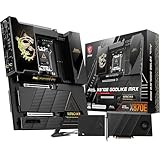
- ULTRA POWER+ and DYNAMIC DASHBOARD III - SUPPORTS THE LATEST RYZEN 9000 PROCESSORS - The MEG X870E GODLIKE MAX employs a 24 DRPS (110A, SPS) for the AMD X870E chipset (AM5, Ryzen), 3.99" LCD for hardware monitoring and personalization
- FROZR GUARD - Premium cooling features such as Wavy fin design, Direct-touch Cross Heat-pipe, 9W/mK MOSFET thermal pads, extra choke thermal pads, double-sided EZ M.2 Shield Frozr II, and Combo-fan (for pump & system) header (3A)
- EZ DIY DESIGN - Multiple DIY-friendly features, such as EZ Link with the EZ Bridge and EZ Control Hub, simplify the PC building process. EZ PCIe Release, EZ Magnetic M.2 Shield Frozr II, and EZ M.2 Clip II simplify assembly for SSD and GPU swaps.
- SEPTUPLE M.2 CONNECTORS and DDR5 MEMORY - Storage include onboard 2 x M.2 Gen5 and 3 x M.2 Gen4 slots with double-sided Shield Frozr. M.2 XPANDER-Z SLIDER GEN5 provides 2 additional M.2 Gen5 slots. 4 x DDR5 DIMM SMT slots (1DPC 1R, 9200+ MT/s OC)
- ULTRA CONNECT - Network hardware includes a full-speed Wi-Fi 7 with Bluetooth 5.4 & 10Gbps plus 5Gbps LAN; Rear ports include USB4 Type-C 40Gbps with display output and 7.1 USB High Performance Audio with Audio Boost 5 HD (supports S/PDIF output)
OC Engine and BCLK tuning
The ACE MAX includes MSI’s OC Engine, which enables asynchronous base-clock tuning. MSI says its BCLK-based tuning can deliver up to 15% higher gaming performance, but that is a vendor claim qualified by game, resolution and system configuration. It should not be read as a typical gain or as a performance advantage provided automatically by the motherboard.
MPG X870I EDGE TI EVO WIFI: a premium Mini-ITX alternative
The MPG X870I EDGE TI EVO WIFI is fundamentally different from the two ATX boards. Its main selling point is a Mini-ITX layout, paired with a white-and-silver design for compact systems.
It uses an 8+2+1 power design with 110A Smart Power Stages and includes a small fan inside the VRM heatsink. The board also provides 5Gb Ethernet, Wi-Fi 7 and two rear USB4 ports with DisplayPort output.
MSI includes a 5-in-1 XPANDER card. The card adds a PCIe 4.0 x4 M.2 slot plus additional USB-C and SATA connectivity, allowing up to three M.2 SSDs in the overall configuration. This gives the small board more storage flexibility than its size might suggest, but the card still consumes space and affects how the system is assembled.
Rank #3

- Support Intel Core Ultra Processors (Series 2)
- Support Dual Channel DDR5 Memory, up to 256GB
- Wi-Fi 7: the latest wireless solution with a new 320MHz channel, achieving a maximum transmission speed of 5.8Gbps
- 10G Super Lan: next level network speed, secure networking with fastest data throughput to improve efficiency
- Ultra Power Plus: the ultimate power solution with 24+1+2+1 DRPS, 110A SPS, and OC engine unleashes maximum CPU performance
Mini-ITX buyers should account for fewer DIMM and expansion slots, higher thermal density, tighter cable management and limited support for multiple PCIe cards. The XPANDER card may also create clearance, airflow or installation issues in some small-form-factor cases. At ¥62,980 tax included in Japan, it is best viewed as a specialist premium compact-build board rather than a direct value competitor to the ATX models.
PRO X870E-S EVO WIFI: the lower-cost X870E option
The PRO X870E-S EVO WIFI brings the X870E chipset to a more restrained ATX design. MSI positions it for professional workloads, business environments and general use, while its ¥39,980 Japanese launch price places it well below the ACE MAX.
The board uses a 12+2+1 power design with 60A Smart Power Stages. That is a positioning difference from the ACE MAX, not proof that it cannot run a high-end Ryzen processor. Sustained performance depends on the CPU, cooling, firmware, power limits and workload.
Free tools Windows power users keep installed
One-click scans. No signup required.
Connectivity includes:
- 5Gb Ethernet
- Wi-Fi 7
- USB4 with 40Gbps transfer and DisplayPort Alt Mode
Its black PCB and silver-white heatsinks give it a less decorative appearance than the MPG model. MSI also focuses on easier installation with the EZ M.2 Clip II, EZ M.2 Shield Frozr II and EZ PCIe Clip II, which is designed to make graphics-card removal simpler.
Rank #4

- ULTRA POWER - SUPPORTS THE LATEST RYZEN 9000 PROCESSORS IN HIGH PERFORMANCE - The MAG B850 TOMAHAWK MAX WIFI employs a 14 Duet Rail Power System (80A, SPS) VRM for the AMD B850 chipset (AM5, Ryzen 9000 / 8000 / 7000) with Core Boost architecture
- FROZR GUARD - Premium cooling features such as 7W/mK MOSFET thermal pads, extra choke thermal pads and an Extended Heatsink; Includes chipset heatsink, EZ M.2 Shield Frozr II, and a Combo-fan (for pump & system) header (3A)
- DDR5 MEMORY, PCIe 5.0 x16 SLOT - 4 x DDR5 DIMM SMT slots enable extreme memory overclocking speeds (1DPC 1R, 8400+ MT/s); 1 x PCIe 5.0 x16 SMT slot (128GB/s) with Steel Armor II supports cutting-edge graphics cards
- QUADRUPLE M.2 CONNECTORS - Storage options include 2 x M.2 Gen5 x4 128Gbps slots, 1 x M.2 Gen4 x4 64Gbps slot and 1 x M.2 Gen4 x2 32Gbps slot; Features EZ M.2 Shield Frozr II to prevent thermal throttling and EZ M.2 Clip II for EZ DIY experience
- CONNECTIVITY - Network hardware includes a full-speed Wi-Fi 7 module with Bluetooth 5.4 & 5Gbps LAN; Rear ports include USB 20G Type-C and 7.1 USB High Performance Audio with Audio Boost 5 (supports S/PDIF output)
The PRO X870E-S makes more sense than the ACE MAX when a build needs X870E-class connectivity, Wi-Fi 7 and USB4 but does not need 10GbE, five M.2 slots, premium audio hardware or advanced BCLK tuning.
What MSI’s MAX and EVO refresh means
All three boards belong to MSI’s broader MAX/EVO refresh strategy. A central feature is a 64MB BIOS ROM, which provides more space for firmware features and is intended to help accommodate future processor support.
That design should not be treated as a guarantee that every future AM5 CPU will work. Processor compatibility remains dependent on MSI firmware and its official CPU support list. New processors and memory kits may also require a BIOS update.
“MAX” and “EVO” are MSI product-family labels; they do not represent new AMD chipset generations. The chipset distinction remains important: the ACE MAX and PRO X870E-S use X870E, while the MPG X870I uses X870. X870E is generally associated with more extensive PCIe 5.0 connectivity, but the chipset name alone does not determine a board’s exact M.2, USB, networking, VRM or audio configuration. It also does not automatically make one board faster in games.
Best Value

- Supports AMD Ryzen 9000/8000/7000 Series Desktop Processors
- Premium Thermal Design: Heavy plated MOSFET heatsink with heat-pipe / high quality 7W/mK MOSFET thermal pads / extra choke thermal pads / onboard M.2 Shield Frozr
- EZ PCIe Release: A simple press of a button to effortlessly lock or unlock the PCIe slot
- Lightning Gen 5: The latest PCIe 5.0 solution with up to 128GB/s bandwidth for maximum transfer speed
- Dual LAN: Dual premium network solution for both Intranet and Internet
Important ACE MAX bandwidth limitations
The ACE MAX’s large expansion and storage feature set comes with lane-sharing rules that should be checked before installing every slot and drive.
Two conflicts to plan around
- PCI_E3 and M.2_1: These connections share bandwidth. Installing a device in PCI_E3 causes M.2_1 to operate at x2. Configuring PCI_E3 for x4 in BIOS disables M.2_1.
- USB 40Gbps and M.2_2: Installing a drive in M.2_2 reduces the USB 40Gbps connection to x2. Switching M.2_2 to x4 in BIOS disables the USB 40Gbps ports.
These limitations do not make the ACE MAX unsuitable for multi-drive systems, but they do mean that its headline slot count is not equivalent to unlimited full-speed connectivity. Read the user guide and slot diagram before finalizing a storage or expansion plan.
Other compatibility points to check
- CPU-dependent PCIe behavior: PCIe lane configurations vary across Ryzen 7000, 8000 and 9000 processors.
- Memory tuning: EXPO, CUDIMM behavior and high memory clocks depend on the CPU’s memory controller, the DIMM layout and BIOS maturity.
- Integrated graphics: HDMI and USB-C DisplayPort output require a processor with integrated graphics.
- Wi-Fi 7: Wi-Fi 7 features and 6GHz operation depend on operating-system support and local regulations.
- Future CPUs: The 64MB BIOS is designed for additional capacity, but unnamed future processors are not guaranteed to be supported.
Which MSI board should you buy?
- Choose the MEG X870E ACE MAX if you need five M.2 slots, multiple PCIe 5.0 connections, 10GbE plus 5GbE, premium audio, extensive diagnostics or BCLK/OC Engine features. It is excessive for a typical single-GPU gaming PC with one or two SSDs and ordinary networking.
- Choose the MPG X870I EDGE TI EVO WIFI if the system must be Mini-ITX, you want the white-and-silver aesthetic, and you can accept limited physical expansion and tighter thermal constraints.
- Choose the PRO X870E-S EVO WIFI if you want an ATX X870E platform with Wi-Fi 7, 5GbE and USB4 at a substantially lower price, without the ACE MAX’s specialized expansion and tuning hardware.
For an ordinary Ryzen gaming build, the deciding factor should be the feature list you will actually use—not the X870E label or the promise of a higher overclocking ceiling.
The Tool Desk
Outbyte PC Repair FREERepair Windows errors before they cause bigger problemsFix Now →Outbyte Driver Updater FREEFix the driver behind crashes, sound loss and screen glitchesFind Drivers →The bottom line
MSI’s three-board launch is meaningful because it covers three different AM5 use cases: a feature-heavy flagship ATX platform, a premium Mini-ITX design and a lower-cost ATX X870E model. The MEG X870E ACE MAX is the most capable of the trio, but its premium is tied to networking, storage, cooling and tuning features rather than an automatic gaming-performance advantage. For compact systems, the MPG X870I is the more relevant choice; for value-focused ATX builds, the PRO X870E-S is likely the better fit.
See MSI’s Japanese launch announcement and the global MAX/EVO overview for regional specifications and availability updates.
Quick Recap
Product prices and availability are accurate as of the date/time indicated and are subject to change. Any price and availability information displayed on Amazon at the time of purchase will apply.

