The Tool Desk
Outbyte PC Repair FREEClear out junk files and repair common Windows errorsFree Scan →Outbyte Driver Updater FREEFix the driver behind crashes, sound loss and screen glitchesFind Drivers →Some links on this page are affiliate links: if you buy through them we may earn a commission, at no extra cost to you.
Hubble did not observe the Crab Nebula for the first time in 2024. It returned to the object after its previous comparable full-nebula observations in 1999–2000, creating a valuable time-lapse of a supernova remnant that is changing on human timescales.
The new comparison confirms the Crab’s continuing expansion and highlights two nearly opposite groupings of filaments with similar emission characteristics. They are scientifically intriguing, but they are not newly formed objects: the structures were faintly present in earlier Hubble data and their physical origin remains unknown.

What Hubble’s new Crab Nebula observations actually show
The central result is straightforward: the Crab Nebula’s filaments have moved outward measurably since Hubble’s 1999–2000 observations. Over roughly a quarter-century, the change is large enough to see when the images are carefully aligned and compared.
The observations also draw attention to two filament groupings positioned nearly opposite each other relative to the nebula’s central pulsar. Their similar emission properties and apparent geometry may offer clues about how the pulsar powers and shapes the nebula—but researchers have not established what produced them.
#1 Best Overall
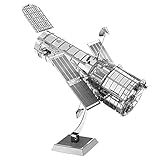
- HOBBY MODEL KIT – Unassembled model packed in an envelope with easy to follow instructions. Ideal for ages 14 and up.
- NO GLUE OR SOLDER NEEDED – Parts can be easily clipped from the metal sheets. Tweezers are the recommended tool for bending and twisting the connection tabs.
- HUBBLE TELESCOPE – 1 Sheet Model with a moderate difficulty level. Assembled Size: 3.00 x 2.00 x 2.50 inches.
- FROM STEEL SHEETS TO 3D – Pop out the pieces and connect using tabs and holes. Includes illustrated instructions.
- HIGHLY DETAILED ETCHED MODEL – Display your 3D model once completed - collect and build them all.
That makes “previously unrecognized filament groupings” more accurate than “surprising new features.” The formations were not suddenly created in 2024.
NASA describes the revisit as a 25-year comparison, while the earlier and newer observing campaigns are more precisely dated to 1999–2000 and 2024. Both “24 years” and “25 years” are rounded descriptions of the same observing gap.
What is the Crab Nebula?
The Crab Nebula is the expanding remnant of SN 1054, a supernova recorded by historical astronomers in 1054 CE. It lies about 6,500 light-years away in the constellation Taurus.
What’s actually slowing this PC down?
Pick the symptom - the matching free tool is one click away.
At its center is a rapidly rotating pulsar—the dense leftover core of the exploded star. The pulsar releases energy into the surrounding debris, powering the nebula’s glowing synchrotron emission and helping drive its complex internal structures.
Unlike a distant galaxy whose visible changes normally take millions of years, the Crab is young and close enough for astronomers to track the motion of individual structures. Its outer filaments have proper motions of roughly 0.3 arcseconds per year or more, making it one of the clearest examples of expansion visible over a human lifetime.
Rank #2

- HOBBY MODEL KIT – Unassembled model packed in an envelope with easy to follow instructions. Ideal for ages 14 and up.
- NO GLUE OR SOLDER NEEDED – Parts can be easily clipped from the metal sheets. Tweezers are the recommended tool for bending and twisting the connection tabs.
- JAMES WEBB SPACE TELESCOPE - 2.75 Sheet Model with a moderate difficulty level. Assembled Size: 4.13 L x 2.75 W x 2.75 H inches. 1:221 Scale. 62 Pieces
- FROM STEEL SHEETS TO 3D – Pop out the pieces and connect using tabs and holes. Includes illustrated instructions.
- HIGHLY DETAILED ETCHED MODEL – Display your 3D model once completed - collect and build them all.
NASA’s general background on the object is available in its Crab Nebula overview.
The Hubble timeline
| Year | Event |
|---|---|
| 1054 CE | Historical observers record the supernova that produced the Crab Nebula. |
| 1999–2000 | Hubble’s WFPC2 camera obtains the earlier full-nebula observations, later assembled into the well-known mosaic. |
| 2009 | Hubble’s Wide Field Camera 3, or WFC3, is installed. |
| 2024 | WFC3 obtains the new optical observations used for the expansion comparison. |
| December 11, 2025 | The research paper describing the program and filament groupings is posted to arXiv. |
| March 23, 2026 | NASA publishes its public account of the 25-year expansion comparison. |
How astronomers can see the nebula expand
The Crab’s filaments are not merely glowing in place. They are pieces of expanding supernova debris, and their angular motion can be measured against a stable reference frame.
Recommended Free Tools
Researchers compare images from different dates, register them carefully, and track the displacement of recognizable filaments. Over the interval between the earlier and newer Hubble campaigns, the outer structures moved outward from the pulsar. NASA’s coverage gives an approximate motion of 3.4 million miles per hour, or about 5.5 million kilometers per hour, for the outward-moving material.
The result is not a claim that every visible pixel has changed in exactly the same way. The nebula contains structures with different shapes, brightnesses and motions. The robust conclusion is that its expansion is visibly measurable.
Why the 2024 images are not simply a new version of the old picture
The earlier and newer observations were made with different Hubble cameras. The 1999–2000 data came from the Wide Field and Planetary Camera 2 (WFPC2); the 2024 observations used the Wide Field Camera 3 (WFC3).
Rank #3
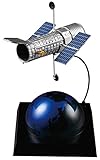
- Sprue Brothers Hasegawa 1:200 Hubble Space Telescope 'The Repair 20th Anniversary', HAS52326
Those instruments differ in detector characteristics, sensitivity, field coverage and filter response. The new program also used a different observing setup, so apparent changes in brightness, color or detail cannot automatically be interpreted as changes in the nebula itself.
The 2024 program used WFC3 observations through:
- F487N, a narrow filter used to provide a relatively uncontaminated hydrogen-band comparison;
- F547M and F763M, continuum filters useful for studying the optical synchrotron nebula.
The research team’s comparison therefore depends on image registration, filter-aware analysis and careful interpretation—not just placing two colorful pictures side by side. NASA explains some of the instrument and image-comparison limitations.
The two nearly opposite filament groupings
The most intriguing new emphasis is on two groups of filaments that stand out from their surroundings and have similar emission characteristics. They lie nearly diametrically opposite one another with respect to the central pulsar.
That geometry raises an obvious question: could the groupings reflect something about the pulsar or the flow of energy it injects into the nebula? It is a reasonable possibility to investigate, but it is not a confirmed explanation.
Several alternatives remain open. The filaments could be influenced by the pulsar wind, shocks, localized density differences, unusual chemical composition, temperature or ionization conditions. They might also be physically connected—or they could simply be unrelated structures that happen to appear opposite each other in projection.
Rank #4
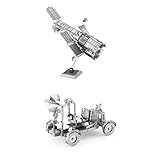
- Set Includes 4 Kits: Hubble Telescope - Apollo Lunar Rover
- Assembly required - Simply pop out the pieces and connect tabs and holes
- Ages 14+ - Moderate
- Hubble Telescope = 3" x 2" x 2.5" when assembled - Easy Difficulty Level
- Apollo Lunar Rover = 3.55" x 1.77" x 2.28" when assembled - Moderate Difficulty Level
The important qualification is that the groupings were already faintly present in earlier Hubble data. The 2024 observations made them more conspicuous as a pair; they did not show two newly born knots or previously unknown objects suddenly appearing inside the nebula.
The original observing program and its discussion of the filament groupings are described in the research paper.
Independent reader supportYour contribution helps us test, update, and keep practical guides available for everyone.What JWST adds
The Hubble and James Webb Space Telescope observations are complementary rather than interchangeable.
Hubble’s optical images resolve the glowing filaments and provide the long time baseline needed to measure their motion against earlier optical data. JWST’s near-infrared and mid-infrared observations emphasize dust and infrared-emitting material, including structures that may be faint or obscured at optical wavelengths.
Do these 3 things before closing this tab:
1Fix the driver behind crashes, sound loss and screen glitches2Repair Windows errors before they cause bigger problems3Scan for outdated or missing drivers - takes under a minuteComparing the datasets helps astronomers distinguish between the Crab’s optical synchrotron emission, ionized gas and dusty components. JWST did not replace Hubble’s role in this result, and the infrared observations do not turn the filament groupings into a solved mystery.
Best Value
What researchers expected—and what they found instead
A 24–25-year gap was long enough to raise the possibility that some prominent features would brighten, fade or otherwise change substantially. Supernova remnants can display evolving structures, so a repeat observation offers more than a prettier image.
The major result reported here is the Crab’s continuing expansion, along with the recognition of the two unusual filament groupings. That should not be misread as evidence that the entire nebula remained unchanged. Rather, the most conspicuous result was not a dramatic global transformation but the continued outward motion of the filaments and the clearer identification of structures already present in the older data.
What is established, and what remains unknown?
| Level of certainty | Conclusion |
|---|---|
| Direct observation | Filaments have moved outward between the 1999–2000 and 2024 Hubble observations. |
| Data interpretation | Two similar filament groupings stand out in nearly opposite positions around the pulsar. |
| Possible implication | The geometry may provide clues about the pulsar-powered flow or other internal dynamics. |
| Unresolved question | The physical origin and relationship of the two groupings are not established. |
Why this revisit matters
The Crab Nebula is a reminder that an astronomical object can look permanent while changing rapidly enough for one generation of instruments to record its motion. Hubble’s value here is not simply its ability to produce a detailed image. Its long operating lifetime creates a time baseline that turns separate observations into a record of astrophysical change.
Quick wins for a faster PC:
Clear out junk files and repair common Windows errorsFree Scan →Scan for outdated or missing drivers - takes under a minuteDriver Scan →Repair Windows errors before they cause bigger problemsFix Now →So the accurate version of the headline is this: Hubble revisited the Crab Nebula in 2024 after its 1999–2000 full-nebula campaign, measured the remnant’s continuing expansion, and highlighted two previously unrecognized, nearly opposite filament groupings whose origin remains unresolved.
Quick Recap
Product prices and availability are accurate as of the date/time indicated and are subject to change. Any price and availability information displayed on Amazon at the time of purchase will apply.

