Do these 3 things before closing this tab:
1Clear out junk files and repair common Windows errors2Fix the driver behind crashes, sound loss and screen glitches3Repair Windows errors before they cause bigger problemsSome links on this page are affiliate links: if you buy through them we may earn a commission, at no extra cost to you.
For most RTX 3060 gaming PCs, a 144Hz or 165Hz monitor is the best balance. Pick 1080p if you want higher frame rates, or 1440p if you prefer a sharper picture and accept adjusting settings in demanding games. A 240Hz screen is mainly for competitive 1080p play when your games and CPU can sustain very high frame rates.
Quick recommendation
| How you use the PC | Good refresh-rate range | Resolution to consider |
|---|---|---|
| General gaming | 144Hz–165Hz | 1080p or 1440p |
| Competitive esports | 165Hz–240Hz | 1080p |
| Demanding new games | 120Hz–165Hz | 1080p or 1440p |
| Story games and mixed use | 120Hz–144Hz | 1440p |
| Lower-budget gaming | 100Hz–120Hz | 1080p |
| Office work with occasional gaming | 75Hz–120Hz | 1080p or 1440p |
These are buying recommendations, not hard limits. Actual frame rates depend on the game, resolution, graphics settings, ray tracing, CPU, and whether your RTX 3060 is a desktop or laptop model. Independent testing finds 1080p the card’s stronger mainstream target, with 1440p viable depending on the game and settings (Tom’s Hardware; TechSpot).
Why 144Hz or 165Hz is the sweet spot
Hz is how many times a monitor can refresh its image each second: 144Hz means up to 144 refreshes per second, for example. It is related to—but not the same as—frames per second (FPS), which is how many frames the game renders. A 165Hz monitor does not make a game run at 165 FPS; the GPU and CPU must produce the frames. Higher refresh rates can make movement look smoother and controls feel more responsive when the system can deliver enough frames (RTINGS).
The RTX 3060 is positioned for modern 1080p and 1440p gaming, not for a promise of maximum settings at a fixed frame rate in every game (NVIDIA; NVIDIA Newsroom). Lighter games, older titles, and esports games can take advantage of a 144Hz or 165Hz panel, particularly at 1080p. Demanding games may run below that at high settings, especially with ray tracing enabled. DLSS, where a game supports it, or reduced settings can improve the performance trade-off.
#1 Best Overall

- 【INTEGRATED SPEAKERS】Whether you're at work or in the midst of an intense gaming session, our built-in speakers provide rich and seamless audio, all while keeping your desk clutter-free.
- 【EASY ON THE EYES】 Protect your eyes and enhance your comfort with Blue-Light Shift technology. This feature reduces harmful blue light emissions from your screen, helping to alleviate eye strain during long hours of use and promoting healthier viewing habits.
- 【WIDEN YOUR PERSPECTIVE】Our sleek minimal bezel design ensures undivided attention. The nearly bezel-free display seamlessly connects in a dual monitor arrangement, delivering an unobstructed view that lets you focus on more at once, completely distraction-free.
A high-refresh monitor is still useful when a game runs below its maximum rate. With variable refresh rate (VRR), the display can adapt to changing frame output within its supported range. That makes a 144Hz or 165Hz VRR screen a more flexible match for frame rates that vary by game than a fixed-refresh screen.
Is 165Hz noticeably better than 144Hz?
It is faster, but the difference is modest: a refresh interval is about 6.94 milliseconds at 144Hz and 6.06 milliseconds at 165Hz. Those figures describe display refresh intervals, not total input lag. Panel response behavior, input lag, VRR, resolution, contrast, and image quality can matter more than the extra 21Hz. Choose 165Hz if it costs about the same or comes with a better panel or warranty; do not dismiss a good 144Hz monitor just for its rating.
Rank #2
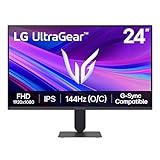
- Vivid Color, Fast Response, Total Control - The 24" UltraGear FHD gaming monitor delivers vivid HDR10 color, ultra-smooth 120Hz speed, and 1ms MBR clarity. G-SYNC compatibility & FreeSync keep gameplay tear-free. The sleek, slim design keep you focused and in control.
- Vivid Color That Puts You in the Action - Step onto the battlefield with HDR10 visuals and up to 99% sRGB color gamut coverage. The IPS display delivers rich, vivid tones, so every explosion, shadow, and landscape appears exactly as the developers intended.
- 120Hz Native Speed (144Hz Overclock) - Enjoy fluid, crystal-clear gameplay with a 120Hz native refresh rate, boosted to 144Hz when overclocked. Minimized motion blur keeps every frame sharp, so you can stay locked in on the action.
- 1ms MBR: Fast-Paced Speed to Victory - 1ms Motion Blur Reduction (MBR) keeps gameplay smooth and sharp, cutting blur and ghosting so fast-moving action stays clear—helping you stay competitive when every millisecond counts.
- NVIDIA G-SYNC Compatible & AMD FreeSync - NVIDIA G-SYNC Compatible and AMD FreeSync deliver smooth, tear-free, low-latency gaming with high refresh rates—so every frame stays sharp.
Choose between 1080p and 1440p
- Choose 1080p if high FPS and competitive play are your priority, your CPU is modest, your budget is limited, or you want the best chance of reaching 144 FPS and beyond. It is a natural fit for a 24- or 25-inch screen.
- Choose 1440p if you value sharper text, more desktop space, and detail in single-player, strategy, or role-playing games. A 27-inch screen is a common fit. Be ready to lower some settings or use DLSS in demanding games, and consider that the monitor may remain useful after a GPU upgrade.
Being able to run a game at 1440p does not mean an RTX 3060 can sustain 165 FPS at ultra settings in every current title. Resolution and refresh rate are a preference trade-off, not a compatibility verdict. A 4K display is possible as a display choice, but 4K gaming places much greater rendering demands on the card and is not the default pairing for someone prioritizing high FPS.
When does 240Hz make sense?
A 240Hz monitor can suit a competitive player who mainly plays lightweight esports titles, regularly sees roughly 200–240 FPS or more, and prioritizes responsiveness over resolution or image quality. For that use, 1080p is usually the more practical choice. A strong CPU matters: at very high frame rates, the CPU or game engine may become the limit before the GPU does.
Rank #3
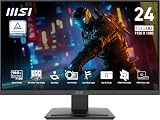
- MSI's 23.8-inch Full HD IPS gaming monitor (1920×1080) delivers a 1500:1 contrast ratio with wide 178°/178° viewing angles — producing deeper blacks, brighter highlights, and accurate colors from virtually any position for gaming and productivity.
- TÜV Rheinland certified Flicker Free and Low Blue Light — eliminating the ~200Hz screen flicker common on standard monitors and reducing harmful blue light exposure to minimize eye strain during extended gaming or work sessions.
- 144Hz high refresh rate delivers ultra-smooth motion and sharper tracking versus standard 60Hz or 75Hz monitors — keeping every frame fluid and responsive for fast-paced FPS, racing, and action games without screen tearing or stuttering.
- MSI's built-in Eye-Q Check provides a vision assessment tool to help optimize display settings for healthier long-term viewing — designed for professionals and students spending extended hours in front of a Full HD IPS screen.
- Tilt-adjustable stand (-5°~20°) for comfortable viewing at any desk setup, with VESA 100×100mm wall mount compatibility for monitor arms, brackets, and multi-monitor arrangements — reducing neck strain during long gaming or work sessions.
For demanding AAA games, a system that usually produces 70–140 FPS will not fully use a 240Hz panel. That does not harm the GPU or make the monitor unusable; it simply means you are paying for refresh capacity you may rarely use. A 240Hz 1440p monitor is generally excessive for an RTX 3060 unless you play unusually light games, reduce settings, or are deliberately buying ahead of a GPU upgrade. Look at sustained FPS and 1% lows in the games you actually play, not just a brief peak.
Does an RTX 3060 support high-refresh monitors?
Yes, in terms of display output: NVIDIA’s reference specifications list a maximum digital resolution of 7680×4320, HDMI and three DisplayPort outputs, support for up to four displays, and G-SYNC support (NVIDIA specifications). Those specifications do not mean the card can render games at 4K or at the monitor’s maximum refresh rate. The monitor, cable, GPU output, resolution, and connection bandwidth must all support the combination.
Rank #4

- up to 180Hz Refresh Rate: Pushing beyond the standard 144Hz, 165Hz gives gamers an edge in visibility as frames transition instantly, leaving behind no blurred images.
- IPS Panel: The IPS (In-Plane Switching) panel cannot be beat when it comes to consistently delivering top color performance and sharp visibility from multiple viewing angles.
- AMD FreeSync: With FreeSync, gamers now enjoy smooth video and seamless on the spot movement through their fast paced games. FreeSync is an AMD technology that nearly eliminates tearing and stuttering due to differences between a graphics card's frame rate and a monitor's refresh rate.
- Edgeless Design: Edgeless Design completely immerses you in all the captivating action and wondrous scenery that 1080P resolution and 165Hz refresh rate have to offer.
- Multiple Digital Ports: While three HDMI ports each deliver an impressive 144Hz refresh rate, one DisplayPort produces a stunning 165Hz refresh rate, all in FHD resolution.
Connector layouts vary between board-partner desktop cards. Laptop RTX 3060 systems can differ further: their available ports and limits depend on the laptop maker, port wiring, USB-C implementation, and configuration. Check the laptop’s manual or technical specifications rather than assuming that a desktop card’s ports or capabilities apply to it.
What’s actually slowing this PC down?
Pick the symptom - the matching free tool is one click away.
Look for VRR as well as a high refresh rate
For a GPU whose frame rate changes substantially between games and settings, VRR is particularly useful. Look for NVIDIA G-SYNC, G-SYNC Compatible, or an adaptive-sync implementation verified for the monitor and connection you plan to use. Check the monitor’s VRR operating range, input lag, response-time behavior, and which input supports its maximum refresh rate. A monitor label alone does not guarantee identical compatibility across every RTX 3060 setup; the monitor, driver, port, cable, and configuration all matter. NVIDIA’s guidance also notes that connection bandwidth and Display Stream Compression (DSC) support can affect high-resolution, high-refresh combinations (NVIDIA Support).
Best Value

- 27" 1500R Up to 160Hz Curved Gaming Monitor FHD 1920x1080P 1Ms (MPRT) for Gaming, Movie, Working,support with 144Hz, 120Hz(depend on signal source device's hardware).
- Gamer-Centric Features: Game Assistant (Black Level Adjustment(shadow booster), Crosshair, Timer, Counter) | Preset Modes (FPS/RTS/Racing/Office/Movie/SRGB).
- Immersive & Clear Viewing: 1500R curvature reduces image distortion and eyestrain. 160Hz refresh rate, 1ms (MPRT) response time, FreeSync
- Color Control: 4000:1 Contrast Ratio, 300 nits Brightness & 110% sRGB color coverage, Low Blue Light, Anti-Flicker/Anti-Glare, HDR Mode(can be enabled in the OSD menu only when connected via an HDMI port). If color not showing great on games, try to change color setting or just turn on the HDR mode.
- Jacks: HDMI 2.0(160Hz max), DP 1.4(160Hz max), Audio Jack(No Speakers) | VESA 100x100mm | Tilt (-5°~15°±2°).
If you see tearing, first check that adaptive sync is enabled in the monitor’s on-screen menu and in the relevant NVIDIA settings. You can test a frame-rate cap slightly below the monitor’s VRR ceiling, but there is no one setting that is best for every game and display. V-SYNC behavior can affect tearing and latency differently, so check the result in the games you play.
Independent reader supportYour contribution helps us test, update, and keep practical guides available for everyone.RTX 3060 8GB and 12GB versions are not identical
The original RTX 3060 is commonly associated with 12GB of VRAM, and an 8GB version also exists. Do not assume the two versions perform identically: TechSpot reported that the 8GB model was 21% behind the 12GB model in its *Halo Infinite* test at 1080p, though differences vary by game, settings, resolution, and driver (TechSpot’s comparison). VRAM capacity does not set a monitor’s refresh rate. It affects what resolutions and settings are practical, while rendering performance, CPU limits, and game workload determine FPS more directly.
Set the monitor to its advertised refresh rate
Connecting a high-refresh monitor does not always enable its maximum rate automatically. In Windows, right-click the desktop, open Display settings, select Advanced display, choose the correct monitor, and select the desired rate from the refresh-rate control. In NVIDIA Control Panel, open Display → Change resolution, select the monitor and refresh rate, then apply the setting. Labels may vary slightly by Windows and driver version. NVIDIA’s support guidance likewise advises selecting the monitor’s advertised rate in display settings (NVIDIA Support).
If a 165Hz monitor offers only 144Hz, or a screen appears stuck at 60Hz, check the following:
- Open the monitor’s on-screen menu and confirm any high-refresh or overclock mode is enabled if the manufacturer requires it.
- On a desktop, connect the monitor directly to an output on the RTX 3060 rather than through a dock, adapter, or KVM. Try DisplayPort if the monitor supports it.
- Check Windows Advanced display and NVIDIA Control Panel to confirm the selected display mode. Test a lower resolution to see whether bandwidth is the issue.
- Check the monitor manual for which input supports the advertised resolution and refresh rate. Cable, HDMI bandwidth, color depth, and laptop port limits can constrain available modes.
- Try another suitable cable and GPU output; update or reinstall the NVIDIA driver if the mode remains missing.
For a laptop, also verify which port is wired to which graphics hardware and whether it supports the monitor’s target mode. A dock or adapter can be the bottleneck even when the laptop and monitor each advertise high refresh rates.
Quick Recap
Recommendations by player type
- Competitive player: Start with 1080p at 165Hz. Consider 240Hz only if your main games regularly reach very high FPS and your CPU can keep up.
- Single-player gamer: Consider 1440p at 144Hz or 165Hz for sharper visuals. Use VRR and adjust demanding settings as needed.
- Mixed-use user: A 1440p 144Hz–165Hz VRR monitor is a versatile option; it offers workspace and image detail without making 240Hz the priority.
- Budget buyer: A 1080p 100Hz–120Hz display can be a worthwhile step up from 60Hz. If the price and quality are close, 144Hz or 165Hz gives more room for games that run faster.
- Future GPU upgrader: A 1440p 165Hz VRR monitor can be a reasonable long-term choice even if the current card cannot reach its maximum in every game. Treat that as a possible benefit, not a guarantee.
Before you buy
- Choose the resolution based on whether you value higher FPS or sharper detail more.
- For most RTX 3060 owners, shortlist 144Hz and 165Hz models before considering 240Hz.
- Check VRR support, operating range, input lag, and response behavior—not just the headline refresh rate.
- Confirm which input and cable support the resolution and refresh rate you want, especially with a laptop, dock, or adapter.
- Compare sustained FPS in your regular games and settings, including demanding scenes and 1% lows.
- Compare panel quality, warranty, and price; the jump from 144Hz to 165Hz is small.
Product prices and availability are accurate as of the date/time indicated and are subject to change. Any price and availability information displayed on Amazon at the time of purchase will apply.

