What’s actually slowing this PC down?
Pick the symptom - the matching free tool is one click away.
Some links on this page are affiliate links: if you buy through them we may earn a commission, at no extra cost to you.
A neural network called AnomalyMatch searched approximately 99.6 million source cutouts from the Hubble Legacy Archive in about two and a half days. Researchers David O’Ryan and Pablo Gómez then manually examined the highest-ranked candidates, confirming more than 1,300 unusual astronomical sources according to NASA’s report. More than 800 had not previously been documented in scientific literature.
The result is significant, but “AI discovered” needs qualification: the system identified and prioritized visually unusual sources. Human researchers determined which candidates were genuine anomalies and what categories they might belong to.


What AnomalyMatch found
The work is described as the first systematic search for astrophysical anomalies across the Hubble Legacy Archive. The published study reports 1,176 newly found anomalies across 19 classes. NASA’s public account gives a broader total of more than 1,300 confirmed anomalies, while ESA describes nearly 1,400. Those figures should not be treated as interchangeable.
Crashes, No Sound, or Screen Glitches?
Random freezes, missing sound and display glitches usually trace back to one bad driver. Find and replace yours safely.Free scan · under a minuteWindows Errors? Fix Them Before They Spread
Repair common Windows errors and clear accumulated junk for a smoother, more stable PC - no reinstall needed.Free scan · no reinstallThe most defensible summary is this: NASA and ESA reported more than 1,300 human-confirmed anomalies, while the formal catalog contains 1,176 newly found anomalies. More than 800 of the sources had not previously been documented in scientific literature.
#1 Best Overall

- EXPLORE THE HUBBLE SPACE TELESCOPE – Celebrate one of humanity’s greatest scientific feats while enjoying a relaxing building experience with the LEGO Icons Hubble Space Telescope (11382) building set for adults ages 18 and up
- REPLICA SPACE MODEL – Recreate the legendary space-based telescope with posable solar arrays and antennas, an opening aperture door and a detailed instrument bay
- AUTHENTIC DETAILS – Remove the exterior panels to reveal a detailed instrument bay, which features gyroscopes alongside primary and secondary mirrors
- PREMIUM SPACE DECOR – Showcase the collectible space model on a shelf or desk using the included stand with information plaque, then add the astronaut minifigure to demonstrate approximate scale
- GIFT IDEA FOR ASTRONOMY FANS – This striking display piece makes an ideal gift for adults who love astronomy and science decor, and is perfect for birthdays, holidays or any special occasion
| Result | Number | How to interpret it |
|---|---|---|
| Source cutouts searched | Approximately 99.6 million | The main dataset analyzed by the paper |
| Processing time | About 2–3 days | NASA gives approximately two and a half days |
| New anomalies in the formal catalog | 1,176 | Reported across 19 classes in the paper |
| NASA’s confirmed-anomaly total | More than 1,300 | A broader public-release figure |
| Previously undocumented in scientific literature | More than 800 | Not the same as objects never seen by anyone |
The difference between the public totals and the formal catalog is not fully reconciled in the available sources. It may reflect different counting scopes, review stages, or rounding. The numbers should therefore be attributed to their respective sources.
What does “anomaly” mean?
In this project, an anomaly is an astronomical source whose shape or visual features differ from patterns the system learned from more typical sources. It does not necessarily violate known physics, represent a new type of object, or remain unexplained.
Some anomalies belong to rare but familiar categories, including galaxy mergers, gravitational lenses, jellyfish galaxies, and collisional ring galaxies. Others do not fit existing classification schemes cleanly and need further investigation.
“Anomaly” is therefore best understood as an unusual candidate requiring scientific attention, not as a synonym for “mystery object.” A source can look strange because of a rare physical structure, projection effects, blending, image artifacts, or limitations in the available data.
How the AI searched Hubble’s archive
AnomalyMatch is a neural-network-based anomaly-search system that combines semi-supervised learning with active learning.
Traditional astronomy classification systems often require large labeled datasets: humans identify examples, and a model learns to recognize those categories. That approach is difficult for rare objects because there may be too few known examples to create a complete training set.
A semi-supervised system can learn from a mixture of labeled and unlabeled data. Active learning allows the model-and-researcher workflow to improve iteratively as experts review selected candidates and provide feedback. Instead of asking astronomers to inspect every source equally, AnomalyMatch searched for unusual patterns in a learned feature space and produced a ranked list for human review.
Do these 3 things before closing this tab:
1Fix the driver behind crashes, sound loss and screen glitches2Clear out junk files and repair common Windows errors3Scan for outdated or missing drivers - takes under a minute- Researchers assembled a consistent subset of Hubble archival observations.
- AnomalyMatch processed approximately 99.6 million small source cutouts.
- The neural network identified sources whose visual features differed from more common patterns.
- It ranked the most promising candidates for inspection.
- O’Ryan and Gómez manually examined the highest-priority sources.
- The researchers organized the confirmed objects into categories and compared them with existing scientific literature.
NASA says the cutouts covered roughly 7–8 arcseconds per side and contained only a few dozen pixels. Processing such a large collection in roughly two and a half days would be impractical for researchers working source by source.
The system did not independently understand the objects, generate physical explanations, or certify new astronomical classes. Its main role was high-throughput discovery and prioritization.
Was the entire Hubble archive searched?
Not in the sense of analyzing every Hubble pixel, instrument, filter, and data product in an identical way.
The Hubble Legacy Archive contains science-ready observations gathered over decades from different programs, instruments, dates, and filters. The formal study used a standardized working dataset dominated by observations from Hubble’s Advanced Camera for Surveys/Wide Field Channel in the F814W filter, using Level 3 science-ready mosaics.
The Tool Desk
Outbyte PC Repair FREERepair Windows errors before they cause bigger problemsFix Now →Outbyte Driver Updater FREEScan for outdated or missing drivers - takes under a minuteDriver Scan →That made a consistent large-scale search possible, but it also introduced selection effects. An object that is faint, invisible, or especially distinctive at another wavelength may be underrepresented. The search was systematic within its selected dataset, not a complete census of every possible anomaly in every Hubble observation.
Rank #3
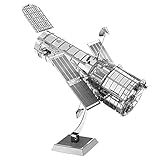
- HOBBY MODEL KIT – Unassembled model packed in an envelope with easy to follow instructions. Ideal for ages 14 and up.
- NO GLUE OR SOLDER NEEDED – Parts can be easily clipped from the metal sheets. Tweezers are the recommended tool for bending and twisting the connection tabs.
- HUBBLE TELESCOPE – 1 Sheet Model with a moderate difficulty level. Assembled Size: 3.00 x 2.00 x 2.50 inches.
- FROM STEEL SHEETS TO 3D – Pop out the pieces and connect using tabs and holes. Includes illustrated instructions.
- HIGHLY DETAILED ETCHED MODEL – Display your 3D model once completed - collect and build them all.
What kinds of objects were found?
Galaxy mergers and interacting galaxies
The largest reported category was galaxy mergers or interactions. The formal catalog includes 417 previously unknown mergers or interacting galaxies.
When galaxies interact, gravity can distort their disks, stretch tidal tails, create elongated structures, or produce multiple overlapping components. These systems help astronomers study how galaxies grow and change, but rare examples can be difficult to find in a huge archive without automated assistance.
Candidate gravitational lenses
The search identified 138 candidate gravitational lenses. A gravitational lens occurs when the gravity of a foreground galaxy or mass concentration bends light from a more distant background object. The result can appear as arcs, stretched images, or ring-like structures.
These are candidates rather than automatically confirmed lenses. Confirmation can require additional imaging, spectroscopy, and mathematical modeling of the foreground mass and background source.
Jellyfish galaxies
The catalog contains 18 jellyfish galaxies. These galaxies can show one-sided gaseous or star-forming structures that resemble tentacles. Their appearance may be linked to interactions with surrounding environments, including the effects of moving through dense galaxy clusters.
Collisional ring galaxies
The researchers reported two collisional ring galaxies. These can form when one galaxy passes through another, sending a wave of star formation through the affected disk. They are rare because the collision geometry and viewing angle have to be favorable.
Rank #4
Edge-on protoplanetary disks
The results also included unusual edge-on planet-forming disks. Seen from the side, these disks can resemble a hamburger or a butterfly-shaped silhouette.
Quick wins for a faster PC:
Clear out junk files and repair common Windows errorsFree Scan →Fix the driver behind crashes, sound loss and screen glitchesFind Drivers →This category also illustrates why the dataset matters. Protoplanetary disks may be better represented in other Hubble instruments, filters, or wavelengths, so the selected F814W-focused search cannot establish how common such objects are across all Hubble observations.
Unclassified objects
Some sources resisted existing categories. ESA has highlighted a bipolar-looking object whose precise nature remains unclear.
“Unclassified” does not mean alien, artificial, or a newly established type of galaxy. It means the available image and current classification scheme do not yet provide a confident explanation.
Were these objects missed for decades?
They were present in archival Hubble observations, but “missed” can be misleading. Most Hubble observations are collected for specific scientific programs. Sources outside the original target may not receive detailed analysis, even when they are visible in the same field.
Recommended Free Tools
The more precise statement is that many objects were previously undocumented in scientific literature. That does not prove no astronomer had ever seen a particular source, cataloged it under another designation, or included it in an unpublished dataset.
Best Value

- 2027 Wall Calendar - Our Hubble Telescope wall calendar covers 12 months from Jan 2027 - December 2027. This 2027 wall calendar with 18 different stunning Hubble space telescope photographs not only help to keep track of your daily tasks but make you feel cool.
- Stay Organized - The 2027 Wall Calendar with federal holidays features unruled daily blocks (1.57''x2''), giving you extra room for jotting down tasks and appointments and making it easy to spot important dates. Past and future monthly referencing in the monthly pages also helps to stay organized.
- Beautiful Pictures - Plan your month with the wondrous beauty of the universe. Each month features a unique scene from space and cool celestial events. Unique hole design can be hung easily on the wall. Perfect addition to any wall in your home, school, or office.
- Premium Quality - The paper of this Hubble Telescope wall calendar 2027 is ink-proof to reduce bleeding, erase fraying and shade issues. Bright white paper to create clean and comfortable writing space.
- Special Gift - A beautiful gift of inspiration, exploration, and wisdom.You can share with your children or friends. This Stunning Hubble Space Telescope Photographs, It brings us not only science and interest, but also the spirit of never giving up, never stopping exploration.
What the result does—and does not—prove
- It does show that automated anomaly searches can examine enormous astronomical archives and produce useful targets for human investigation.
- It does show that old observations can yield new catalogs and research opportunities.
- It does not show that AI independently validated hundreds of new physical phenomena.
- It does not show that every candidate gravitational lens is a confirmed lens.
- It does not show that every unusual-looking source belongs to a new class of galaxy.
- It does not show that the objects had never been viewed by a human being.
Visual unusualness can result from detector defects, cosmic rays, saturation, background-subtraction problems, source blending, projection effects, incomplete field coverage, or a rare but understood morphology. Human inspection and follow-up observations remain essential.
Why archival AI searches matter
The broader importance of AnomalyMatch is methodological. Astronomy has accumulated enormous collections of observations, but researchers cannot inspect every source in equal detail. Rare objects are particularly easy to overlook because standard searches are often designed to find known categories.
Anomaly detection changes the first question from “Which known object is this?” to “Does this source look different from the usual patterns?” That can help researchers discover rare examples, expand samples for population studies, and identify targets for follow-up observations.
Free tools Windows power users keep installed
One-click scans. No signup required.
The approach will become increasingly useful as projects such as large astronomical surveys and AI-assisted archive analysis generate or expose more data. Future facilities and surveys, including Euclid, the Vera C. Rubin Observatory, and the Nancy Grace Roman Space Telescope, will make automated triage increasingly important.
AI does not replace astronomers in this workflow. It helps decide which sources deserve their limited attention.
What happens next?
The next stage is scientific validation. Researchers can cross-match the candidates with other catalogs, obtain follow-up imaging or spectroscopy, model candidate gravitational lenses, and investigate whether apparently similar sources share a physical origin.
Some objects will likely receive familiar explanations. Others may become valuable examples of rare processes. A smaller number could challenge existing classifications, but that conclusion requires evidence beyond an unusual Hubble image.
The most important lesson is therefore not that a machine independently found hundreds of cosmic mysteries. It is that a neural network helped astronomers search an enormous existing dataset systematically, turning archival observations into a prioritized list of objects that humans can study in detail.
Quick Recap
Sources
- NASA: AI unlocks hundreds of cosmic anomalies in Hubble’s archive
- O’Ryan and Gómez: Identifying astrophysical anomalies in 99.6 million source cutouts from the Hubble Legacy Archive using AnomalyMatch
- NASA-hosted published paper
- ESA: 1,400 quirky objects found in Hubble’s archive
Product prices and availability are accurate as of the date/time indicated and are subject to change. Any price and availability information displayed on Amazon at the time of purchase will apply.

