Some links on this page are affiliate links: if you buy through them we may earn a commission, at no extra cost to you.
The glowing “jellyfish” was not a nebula, aurora, UFO, or unknown atmospheric creature. It was the expanding exhaust plume from the second stage of a SpaceX Falcon 9 launched from Cape Canaveral, Florida, on March 4, 2026.
The unusual shape appeared because the rocket had climbed into sunlight while observers on the ground were still in darkness, 52 minutes before sunrise. Sunlight illuminated the high-altitude plume, turning ordinary rocket exhaust into a broad, luminous cloud against the predawn sky. NASA’s Astronomy Picture of the Day explanation identifies the plume as consisting largely of water vapor and carbon dioxide.
What created the glowing jellyfish?
The photographed object was a real cloud of rocket exhaust, but “jellyfish” was only a visual description. The Falcon 9’s second stage was continuing its journey toward orbit when its exhaust expanded high above the Earth. From the ground, the plume formed a bright central region with trailing, tentacle-like extensions.
The image was taken during a launch from Cape Canaveral on March 4, 2026. NASA later featured the photograph on Astronomy Picture of the Day on March 19, crediting photographer Michael Seeley and identifying Cecilia Chirenti of NASA GSFC, the University of Maryland, and CRESST II as the author of the explanation.
#1 Best Overall
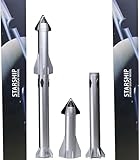
- Extremely exquisite SpaceX starship rocket model (For collection or display, not a toy! Children should not buy it)
- This model is a highly simulated SpaceX starship rocket model. The main body of the first-level super heavy booster is made of precision aluminum alloy tubes. The second-level starship is embedded with reinforced aluminum alloy tubes. The rest of the rocket materials are made of high-quality imported resin. Excellent laser forming ability and long-lasting storage
- The proportional model:1:375
- Actual height: 32cm (the core diameter is 24mm, the real rocket is 9 meters in diameter) This ratio is the best choice for desktop placement
- Note: This model is not a toy model, it is not recommended to buy for children, please buy with caution to avoid unnecessary trouble for your shopping
Why was the plume glowing before sunrise?
The key is that sunrise happens at the observer’s location, not everywhere above the observer at the same time.
Before sunrise, the ground in Florida was still on the dark side of Earth. But the Falcon 9 had rapidly climbed to an altitude where the Sun was already above the local horizon. Sunlight struck the expanding exhaust from above while the lower atmosphere and ground remained in darkness.
That contrast made the plume look like a luminous object suspended in the sky. The exhaust was not simply a giant flame burning visibly over Florida. The dramatic glow primarily came from sunlight reflecting and scattering through the high-altitude exhaust cloud.
Quick wins for a faster PC:
Fix the driver behind crashes, sound loss and screen glitchesFind Drivers →Clear out junk files and repair common Windows errorsFree Scan →In simple terms: the observer was in darkness, but the rocket plume was high enough to be in daylight.
This belongs to the same broad family of twilight effects that can make high-altitude contrails, rocket plumes, and some high clouds glow before sunrise or after sunset. NASA’s APOD archive includes other SpaceX plume photographs, including a February 17, 2025 example described as visible at great distance because of twilight illumination.
Rank #2

- Extremely exquisite Falcon 9 STRONGBACK rocket model (For collection or display, not a toy! Children should not buy it)
- First-stage super heavy-duty booster is made of precise aluminum alloy tubes. Other parts constructed with High-quality imported laser-formed photosensitive resin-it rocket material
- The proportional model:1:233
- Actual height: 32cm (the core diameter is 24mm, the real rocket is 9 meters in diameter) This ratio is the best choice for desktop placement
- Note: This model is not a toy model, it is not recommended to buy for children, please buy with caution to avoid unnecessary trouble for your shopping
Why did it look as if the jellyfish was falling?
The plume was not falling toward Florida as a giant cloud. Its apparent downward motion was a perspective effect.
A rocket does not continue straight upward above the launch site. After the initial ascent, it turns downrange and follows a trajectory around the curved Earth. A distant observer can therefore see the vehicle’s path tilt or appear to drop. The exhaust also continues expanding after the rocket has moved away from the brightest part of the image.
Free tools Windows power users keep installed
One-click scans. No signup required.
The photograph captures several things at once: the rocket’s changing position, the spreading exhaust, the curvature of Earth, and the observer’s viewing angle. Together, they can make an ascending orbital vehicle appear to stall or descend.
Which part of the Falcon 9 produced it?
The glowing cloud came from the second stage, not simply from the reusable first-stage booster.
- First stage: provides the initial thrust and later separates from the vehicle, typically returning for a landing.
- Second stage: continues accelerating the payload toward orbit and produces the high-altitude exhaust plume seen in the image.
NASA’s explanation specifically identifies the visible plume as second-stage exhaust. It describes that exhaust as largely water vapor and carbon dioxide. The exact appearance of any plume depends on the engine, propellants, altitude, atmospheric conditions, sunlight, viewing angle, and camera exposure.
Rank #3
- Durable materials: This 1/400 scale SpaceX spaceship is lightweight and durable. The main body of the spaceship is made of pp and precision aluminum alloy. It is very suitable for desktop display
- Exquisite Details: The height of the rocket model is 4.9 inches and the diameter is 1.81 inches. It precisely reproduces the launch configuration of the rocket and captures every real detail of the authentic interstellar spacecraft
- Perfect Display or Gift: This complete rocket launch model brings the real space flight scene to life, making it an ideal choice for a desk or display stand. It creates a charming atmosphere for space enthusiasts and is the perfect gift for any space lover
- The Package Includes: This Starship model set includes a 1/400 scale Starship Rocket Model. Gift packaging is available. The complete kit vividly recreates the scene of the Starship
- Note: This model is suitable for desktop display and has fulfilled the dreams of every enthusiast. It is not applicable to children's toys
Was it an aurora, meteor, nebula, or UFO?
No. The launch provides a conventional explanation for the display.
| What it might resemble | What it actually is |
|---|---|
| Aurora | An aurora is produced when energetic particles interact with gases in Earth’s upper atmosphere. This display was tied directly to a rocket launch and illuminated exhaust. |
| Meteor | A meteor is a brief streak or flare caused by an object entering the atmosphere. It does not normally form a slowly expanding cloud that follows an orbital launch. |
| Nebula | A nebula is a distant astronomical cloud. The “jellyfish” was a temporary plume within Earth’s atmosphere. |
| UFO or unexplained craft | The Falcon 9 launch, exhaust plume, trajectory, and sunlight geometry account for the image without requiring an unknown object. |
The display may look extraordinary, but unusual-looking does not mean unexplained. NASA places this type of event among twilight phenomena, which have sometimes been mistaken for UFOs.
Why did the plume spread into a broad, tentacled shape?
Rocket exhaust expands rapidly after leaving the engine nozzle. At high altitude, it disperses through much thinner air than exists near the ground. Meanwhile, the second stage was moving downrange rather than remaining directly above the launch site.
That combination created a changing, three-dimensional cloud viewed from an angle. The rocket’s trajectory supplied the apparent direction, while expansion and sunlight made the exhaust broad and diffuse. The resulting image looked more like a glowing jellyfish than a narrow vertical rocket trail.
The camera also matters. A photograph can collect faint light over an exposure longer than the eye’s momentary view, while a wide-angle lens and image processing can make a diffuse plume appear more expansive and saturated. That does not mean the image was fabricated; it means a camera records the event differently from unaided vision.
Recommended Free Tools
Rank #4

- 1:200 Scale SpaceX Starship Model: This NikolaToy model offers a precise 1:200 scale replica of the SpaceX Starship, showcasing a realistic design for aviation and space enthusiasts.
- LED Lights & Misting Effect: Equipped with LED lights and a misting function, this model creates a dynamic and interactive experience, simulating rocket exhaust in a unique way.
- Durable PLA+ Construction: Made from PLA+, a strong and eco-friendly material, ensuring a sturdy, long-lasting model with fine detailing.
- Precision 3D Printing: Crafted with high-precision 3D printing technology to capture every detail of the SpaceX Starship, from its sleek body to the intricate features.
- Ideal Gift for Space Enthusiasts: A perfect gift for space lovers, engineers, or collectors, adding both a decorative touch and an engaging conversation piece to any home or office.
What caused the unusual colors?
Reports and images show blue and orange tones, but they should not be treated as a chemical color chart. The visible colors depend on the angle and intensity of sunlight, the changing shape and density of the plume, the dark predawn background, atmospheric conditions, and camera exposure.
Without a dedicated spectroscopic analysis, it is not sound to assign each color to a particular exhaust chemical. The reliable conclusion is that sunlight interacting with an expanding plume produced the unusual appearance.
What was the launch carrying?
The event occurred during a routine SpaceX Falcon 9 orbital launch. The Daily Galaxy reported that the mission carried 29 Starlink satellites and identified additional booster and mission details. Those payload and hardware specifics are secondary reporting and are not needed to explain the “jellyfish” effect.
The firmly established point is the vehicle and phenomenon: a SpaceX Falcon 9 launched from Cape Canaveral, and its second-stage exhaust was illuminated high above a darkened observer. The image alone should not be used to infer a launch failure or to establish precise mission statistics.
What’s actually slowing this PC down?
Pick the symptom - the matching free tool is one click away.
Was the display dangerous?
Nothing in NASA’s explanation identifies an explosion, malfunction, or atmospheric threat. The appearance is consistent with an illuminated rocket plume viewed under favorable twilight geometry.
Best Value

- Name:1:233 Falcon 9 Block 5 Material::Alloy+resin
- Size:Approximately 22x7cm (8.6*2.7inch) Function: Static desktop display
- For collection or display, Not suitable for children to play with Handmade, there may be minor flaws
- Model is a highly Simulated SpaceX Falcon9 Dragon+F9 Starship Heavy Falcon Falcon 9 Biock 5 rocket model. The main body of the first-stage rocket is precision aluminum alloy tube, and the rest of the rocket materials are made of high-quality imported resin-with excellent laser forming ability and long-lasting preservation
That conclusion applies to this specific display, not to rocket launches in general. Space launches involve complex vehicles and regulated safety zones, but the glowing cloud itself was not evidence that a giant object was descending toward people on the ground.
Why do these effects happen around dawn and dusk?
A dramatic rocket plume is more likely when several conditions align:
- The launch occurs shortly before sunrise or after sunset.
- The upper stage climbs high enough to enter sunlight.
- The observer remains in darkness or deep twilight.
- The exhaust is diffuse enough to scatter sunlight across a large area.
- The trajectory and viewing angle make the expanding cloud appear broad or tentacled.
Cloud cover, atmospheric transparency, the observer’s distance from the launch site, and the camera’s exposure settings also affect visibility. That is why a similar effect does not appear after every launch, even though rocket exhaust and twilight geometry are recurring phenomena.
The Tool Desk
Outbyte PC Repair FREERepair Windows errors before they cause bigger problemsFix Now →Outbyte Driver Updater FREEFix the driver behind crashes, sound loss and screen glitchesFind Drivers →How long did it last?
There is no reliable precise duration established by the available explanation. The shape changed quickly as the exhaust expanded, dispersed, and moved across the sky. It also became harder to see as the sky brightened toward sunrise.
It is more accurate to describe the event as transient than to assign it a specific number of minutes based only on the photograph.
The simplest explanation
The “jellyfish” was a fleeting optical and atmospheric display created by an ordinary part of an orbital launch. The Falcon 9’s second stage released exhaust high above Earth; the Sun illuminated that plume while Florida remained in darkness; and perspective turned its expanding shape into what looked like a glowing creature.
It was real as a photographed exhaust cloud, but not a living object, deep-space nebula, aurora, meteor, UFO, or new atmospheric phenomenon.
Quick Recap
Product prices and availability are accurate as of the date/time indicated and are subject to change. Any price and availability information displayed on Amazon at the time of purchase will apply.

