

I love big silicon jumps as much as the next tech nerd. But every time we get close to a new process node, I ask the same question: is this about making phones better, or just making the top tier more expensive. With Qualcomm’s rumoured 2nm Snapdragon plans, I am leaning toward the latter.
According to reliable leaker Digital Chat Station, Qualcomm is not building one next-gen flagship chip, but two. The leaked model numbers are SM8950 and SM8975, both reportedly built on TSMC’s 2nm N2P process. SM8950 is the “standard” flagship, while SM8975 is a Pro or Ultra-only part.
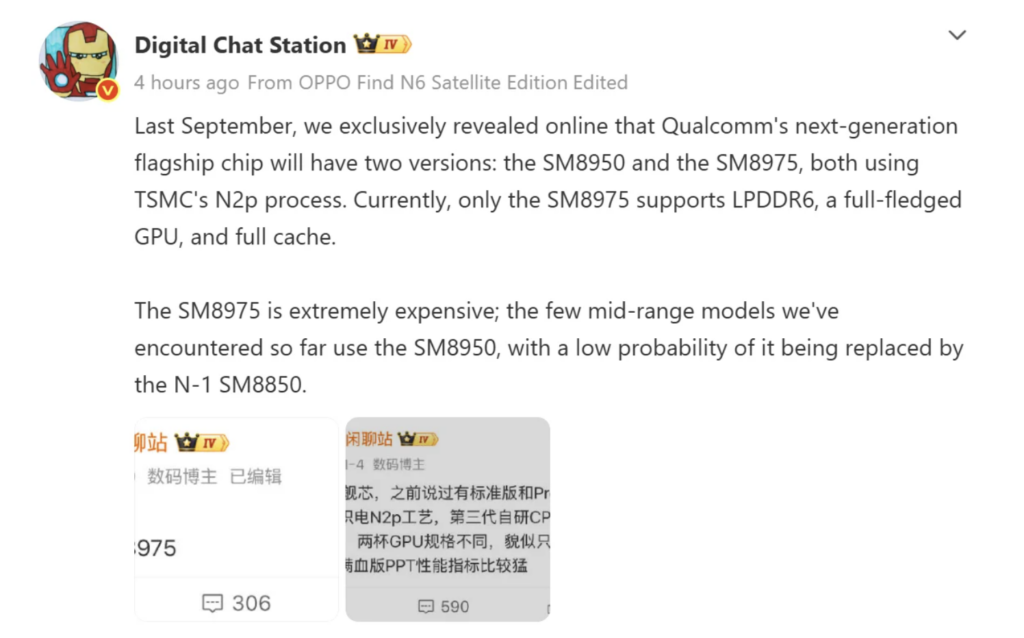
What is actually new here is not just the move to 2nm. It is the intentional segmentation. According to leaks, the higher-end SM8975 is expected to support LPDDR6 memory, have a fully enabled GPU, and ship with a larger cache configuration.
The SM8950, meanwhile, is expected to make compromises, likely sticking with LPDDR5X and trimmed GPU or cache resources. None of this is officially confirmed, so this is still interpretation based on multiple aligned leaks. But the pattern is hard to ignore.
There are also architectural rumours floating around. Several outlets mention a 2+3+3 CPU cluster layout, which would be a change from the more familiar 2+6 design. Android Authority also notes talk of a new Adreno GPU generation, sometimes referred to as Adreno 850. Again, these are just rumours, but the agreement across sources suggests Qualcomm is reworking more than just the manufacturing node.
The 2nm angle matters because of cost. TSMC’s N2 and N2P nodes are widely expected to be far more expensive than today’s 3nm processes. Android Central points out that while efficiency gains could be substantial, the wafer costs are eye-watering. This is where the SM8975 starts to feel less like a technical necessity and more like a business lever.
Multiple reports suggest the Pro chip is “extremely expensive,” to the point where some phone makers may avoid it altogether or reserve it strictly for halo devices.
To me, this looks like Qualcomm formalising what phone brands already do. Create a silicon tier so premium that it justifies Ultra pricing, while the “regular” flagship suddenly feels reasonable by comparison.
It is clever, but it is not consumer-friendly. If LPDDR6 and the best GPU performance are locked behind the most expensive phones, innovation becomes a luxury feature. It is also worth noting that, Qualcomm could still hedge by using Samsung’s 2nm process for certain variants, especially after comments from CEO Cristiano Amon about working with Samsung Foundry.
Certain reports downplay this, suggesting TSMC remains the primary partner. MediaTek also looms in the background, with talk of a 2nm Dimensity 9600 potentially challenging Qualcomm’s non-Pro chip. That competitive pressure may be part of why this split exists at all.
What I will be watching next is how brands respond. If most flagships ship with SM8950, that tells us everything about the real value equation. If SM8975 becomes the new Ultra badge, then 2026 is not just the year of 2nm. It is the year silicon became another upsell checkbox.
